
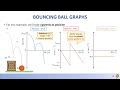
Vertical Projectile Motion Concepts

Interactive Video
•
Physics
•
10th - 12th Grade
•
Practice Problem
•
Hard

Patricia Brown
FREE Resource
Read more
10 questions
Show all answers
1.
MULTIPLE CHOICE QUESTION
30 sec • 1 pt
Which of the following graphs is used to describe vertical projectile motion?
Position-time graph
Force-time graph
Energy-time graph
Momentum-time graph
2.
MULTIPLE CHOICE QUESTION
30 sec • 1 pt
What does the slope of a velocity-time graph represent?
Displacement
Acceleration
Time
Speed
3.
MULTIPLE CHOICE QUESTION
30 sec • 1 pt
When drawing a vertical projectile motion graph, why is it important to choose a reference position?
To find the time of flight
To calculate the mass of the object
To set the zero point for displacement
To determine the color of the graph
4.
MULTIPLE CHOICE QUESTION
30 sec • 1 pt
In a position-time graph for a dropped ball, what does a zero slope indicate?
Decreasing velocity
Increasing velocity
Zero velocity
Constant velocity
5.
MULTIPLE CHOICE QUESTION
30 sec • 1 pt
For a dropped ball, what is the shape of the position-time graph?
Circular
Exponential
Parabolic
Linear
6.
MULTIPLE CHOICE QUESTION
30 sec • 1 pt
When a ball is thrown downwards, how does the initial velocity affect the velocity-time graph?
It starts at a constant value
It starts at a positive value
It starts at zero
It starts at a negative value
7.
MULTIPLE CHOICE QUESTION
30 sec • 1 pt
In the case of a ball thrown upwards, what happens to the velocity at the highest point?
It is zero
It is constant
It is minimum
It is maximum
Access all questions and much more by creating a free account
Create resources
Host any resource
Get auto-graded reports

Continue with Google

Continue with Email

Continue with Classlink

Continue with Clever
or continue with

Microsoft
%20(1).png)
Apple

Others
Already have an account?
Similar Resources on Wayground
Popular Resources on Wayground

7 questions
History of Valentine's Day
Interactive video
•
4th Grade
15 questions
Fractions on a Number Line

Quiz
•
3rd Grade
20 questions
Equivalent Fractions
Quiz
•
3rd Grade
25 questions
Multiplication Facts
Quiz
•
5th Grade
22 questions
fractions
Quiz
•
3rd Grade
15 questions
Valentine's Day Trivia
Quiz
•
3rd Grade
20 questions
Main Idea and Details
Quiz
•
5th Grade
20 questions
Context Clues
Quiz
•
6th Grade
Discover more resources for Physics
21 questions
Potential and Kinetic Energy
Quiz
•
11th Grade
15 questions
Circuits Review Quiz
Quiz
•
12th Grade
20 questions
Unit 8 - Energy Test - 2025-2026
Quiz
•
9th - 12th Grade
19 questions
Generators, Motors, and Transformers
Quiz
•
8th Grade - University
13 questions
Series Circuits and Parallel Circuits
Quiz
•
12th Grade
14 questions
Bill Nye Waves
Interactive video
•
9th - 12th Grade
41 questions
5.1 Review Part 2
Quiz
•
10th Grade
11 questions
Conservation of Momentum: Physics in Motion Video
Interactive video
•
10th Grade