
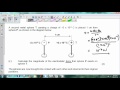
Electrostatics Concepts and Calculations

Interactive Video
•
Physics
•
9th - 10th Grade
•
Practice Problem
•
Hard

Patricia Brown
FREE Resource
Read more
10 questions
Show all answers
1.
MULTIPLE CHOICE QUESTION
30 sec • 1 pt
What is the direction of the electric field lines around a negatively charged sphere?
Circular around the sphere
Inwards radially
Outwards radially
Parallel to the surface
2.
MULTIPLE CHOICE QUESTION
30 sec • 1 pt
How do you calculate the number of excess electrons on a charged sphere?
Subtract the charge of an electron from the charge
Add the charge to the charge of an electron
Divide the charge by the charge of an electron
Multiply the charge by the charge of an electron
3.
MULTIPLE CHOICE QUESTION
30 sec • 1 pt
What is the charge of an electron typically given as?
-1.6 * 10^-19 C
1.6 * 10^-19 C
-1.6 * 10^-9 C
1.6 * 10^-9 C
4.
MULTIPLE CHOICE QUESTION
30 sec • 1 pt
Which equation is used to calculate the electrostatic force between two charged spheres?
F = ma
F = qE
F = mv^2/r
F = k(q1q2)/r^2
5.
MULTIPLE CHOICE QUESTION
30 sec • 1 pt
What is the unit of electrostatic force?
Volts
Coulombs
Newtons
Joules
6.
MULTIPLE CHOICE QUESTION
30 sec • 1 pt
What happens to the charge on each sphere after they are brought into contact and then separated?
The charges remain the same
The charges are redistributed equally
The charges are doubled
The charges are neutralized
7.
MULTIPLE CHOICE QUESTION
30 sec • 1 pt
Which equation is used to calculate the electrical potential energy between two charged spheres?
U = k(q1q2)/r
U = qV
U = 1/2 CV^2
U = mgh
Access all questions and much more by creating a free account
Create resources
Host any resource
Get auto-graded reports

Continue with Google

Continue with Email

Continue with Classlink

Continue with Clever
or continue with

Microsoft
%20(1).png)
Apple

Others
Already have an account?


