
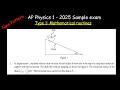
Rotational Motion and Forces

Interactive Video
•
Physics
•
11th - 12th Grade
•
Practice Problem
•
Hard

Patricia Brown
FREE Resource
Read more
10 questions
Show all answers
1.
MULTIPLE CHOICE QUESTION
30 sec • 1 pt
What is the significance of the disc rolling without slipping in the experiment?
It reduces the friction between the disc and the surface.
It prevents the disc from accelerating.
It allows the disc to have both translational and rotational motion.
It ensures the disc moves in a straight line.
2.
MULTIPLE CHOICE QUESTION
30 sec • 1 pt
Which force is responsible for the disc's rotational motion?
Gravitational force
Normal force
Frictional force
Centripetal force
3.
MULTIPLE CHOICE QUESTION
30 sec • 1 pt
Why can't the normal force provide torque to the disc?
It acts at the center of mass.
It is perpendicular to the displacement.
It acts in the direction of motion.
It is too weak compared to other forces.
4.
MULTIPLE CHOICE QUESTION
30 sec • 1 pt
What is the expression for net torque on the disc in terms of friction?
Torque = R * FF
Torque = FF * sin(Theta)
Torque = M * g * sin(Theta)
Torque = I * Alpha
5.
MULTIPLE CHOICE QUESTION
30 sec • 1 pt
How is the net force on the disc calculated using Newton's Second Law?
Net force = m * g * sin(Theta) + FF
Net force = m * g * cos(Theta)
Net force = m * g * sin(Theta) - FF
Net force = FF - m * g * sin(Theta)
6.
MULTIPLE CHOICE QUESTION
30 sec • 1 pt
What is the relationship between linear acceleration and angular acceleration for the disc?
Alpha = a / R
Alpha = a * R^2
Alpha = a * R
Alpha = R / a
7.
MULTIPLE CHOICE QUESTION
30 sec • 1 pt
What is the linear acceleration of the disc's center of mass?
a = g * cos(Theta)
a = 3/2 * g * sin(Theta)
a = 2/3 * g * sin(Theta)
a = g * sin(Theta)
Access all questions and much more by creating a free account
Create resources
Host any resource
Get auto-graded reports

Continue with Google

Continue with Email

Continue with Microsoft
or continue with

%20(1).png)
Apple

Others
Already have an account?

