
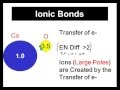
Types of Chemical Bonds and Electronegativity

Interactive Video
•
Chemistry
•
9th - 10th Grade
•
Practice Problem
•
Hard

Patricia Brown
FREE Resource
Read more
10 questions
Show all answers
1.
MULTIPLE CHOICE QUESTION
30 sec • 1 pt
What is the main characteristic of a non-polar covalent bond?
Complete transfer of electrons
Even sharing of electrons
Formation of ions
Uneven sharing of electrons
2.
MULTIPLE CHOICE QUESTION
30 sec • 1 pt
In a non-polar covalent bond, what is the difference in electronegativity between the atoms?
0.5
1.0
0
2.0
3.
MULTIPLE CHOICE QUESTION
30 sec • 1 pt
Which of the following best describes a polar covalent bond?
Electrons are shared equally
No electrons are involved
Electrons are transferred completely
Electrons are shared unequally
4.
MULTIPLE CHOICE QUESTION
30 sec • 1 pt
What happens to the electrons in a polar covalent bond?
They are transferred to another atom
They are pulled towards the more electronegative atom
They are evenly distributed
They remain stationary
5.
MULTIPLE CHOICE QUESTION
30 sec • 1 pt
What is the result of the complete transfer of electrons in an ionic bond?
Equal sharing of electrons
No charge on atoms
Creation of ions with full charges
Formation of a covalent bond
6.
MULTIPLE CHOICE QUESTION
30 sec • 1 pt
In an ionic bond, what type of charge does the atom that gains electrons acquire?
No charge
Positive
Negative
Neutral
7.
MULTIPLE CHOICE QUESTION
30 sec • 1 pt
How does the difference in electronegativity affect the type of bond formed?
Larger differences lead to non-polar bonds
Smaller differences lead to ionic bonds
Larger differences lead to ionic bonds
No effect on bond type
Access all questions and much more by creating a free account
Create resources
Host any resource
Get auto-graded reports

Continue with Google

Continue with Email

Continue with Classlink

Continue with Clever
or continue with

Microsoft
%20(1).png)
Apple

Others
Already have an account?

