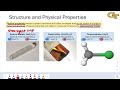
Intermolecular Forces and Molecular Properties

Interactive Video
•
Chemistry
•
10th - 12th Grade
•
Practice Problem
•
Hard

Patricia Brown
FREE Resource
Read more
10 questions
Show all answers
1.
MULTIPLE CHOICE QUESTION
30 sec • 1 pt
What is the primary focus of the video tutorial?
The connection between molecular structure and physical properties
The chemical reactions of organic compounds
The synthesis of new organic compounds
The history of organic chemistry
2.
MULTIPLE CHOICE QUESTION
30 sec • 1 pt
Which of the following is NOT a physical property?
Chemical reactivity
Solubility
Boiling point
Melting point
3.
MULTIPLE CHOICE QUESTION
30 sec • 1 pt
What state is sodium acetate at room temperature?
Plasma
Gas
Liquid
Solid
4.
MULTIPLE CHOICE QUESTION
30 sec • 1 pt
Which intermolecular force is considered the strongest?
Dipole-dipole interactions
Hydrogen bonds
Ion-ion forces
London dispersion forces
5.
MULTIPLE CHOICE QUESTION
30 sec • 1 pt
What type of intermolecular force is dominant in hydrocarbons?
London dispersion forces
Ion-dipole forces
Dipole-dipole interactions
Hydrogen bonds
6.
MULTIPLE CHOICE QUESTION
30 sec • 1 pt
Which intermolecular force explains the solubility of sodium chloride in water?
Hydrogen bonds
Ion-dipole forces
Dipole-dipole interactions
London dispersion forces
7.
MULTIPLE CHOICE QUESTION
30 sec • 1 pt
What does 'hydrophilic' mean?
Non-polar
Water-loving
Water-fearing
Oil-loving
Access all questions and much more by creating a free account
Create resources
Host any resource
Get auto-graded reports

Continue with Google

Continue with Email

Continue with Classlink

Continue with Clever
or continue with

Microsoft
%20(1).png)
Apple

Others
Already have an account?
Similar Resources on Wayground

11 questions
Dissolved Oxygen in Aquatic Habitats
Interactive video
•
11th Grade - University
11 questions
Understanding Reactivity and Shielding in the Periodic Table
Interactive video
•
9th - 12th Grade
8 questions
IUPAC Nomenclature of Alkanes: Part 2
Interactive video
•
11th Grade - University
11 questions
Understanding Isotopes and Radioactivity
Interactive video
•
9th - 12th Grade
6 questions
Dividing Powers: The Quotient Property
Interactive video
•
10th - 12th Grade
Popular Resources on Wayground
5 questions
This is not a...winter edition (Drawing game)

Quiz
•
1st - 5th Grade
25 questions
Multiplication Facts
Quiz
•
5th Grade
10 questions
Identify Iconic Christmas Movie Scenes
Interactive video
•
6th - 10th Grade
20 questions
Christmas Trivia
Quiz
•
6th - 8th Grade
18 questions
Kids Christmas Trivia
Quiz
•
KG - 5th Grade
11 questions
How well do you know your Christmas Characters?

Lesson
•
3rd Grade
14 questions
Christmas Trivia
Quiz
•
5th Grade
20 questions
How the Grinch Stole Christmas
Quiz
•
5th Grade
Discover more resources for Chemistry
20 questions
Ionic Compound Nomenclature
Quiz
•
9th - 12th Grade
30 questions
ERHS Chem - Chapter 6 Covalent Compounds
Quiz
•
11th Grade
42 questions
Chemistry Final Exam Review
Quiz
•
9th - 12th Grade
43 questions
Electron Configuration and Orbital Notation
Quiz
•
10th Grade
35 questions
Chemistry Semester A Final Review
Quiz
•
11th Grade