
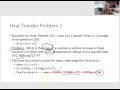
Heat Transfer and Gas Laws

Interactive Video
•
Physics
•
9th - 10th Grade
•
Practice Problem
•
Hard

Patricia Brown
FREE Resource
Read more
10 questions
Show all answers
1.
MULTIPLE CHOICE QUESTION
30 sec • 1 pt
What is the Celsius equivalent of 97 degrees Fahrenheit?
36.1 degrees Celsius
38.2 degrees Celsius
37.5 degrees Celsius
35.0 degrees Celsius
2.
MULTIPLE CHOICE QUESTION
30 sec • 1 pt
How do you convert Celsius to Kelvin?
Subtract 273 from Celsius
Divide Celsius by 273
Add 273 to Celsius
Multiply Celsius by 273
3.
MULTIPLE CHOICE QUESTION
30 sec • 1 pt
What is the formula for calculating heat transfer?
Q = m / c / ΔT
Q = m - c - ΔT
Q = m + c + ΔT
Q = m * c * ΔT
4.
MULTIPLE CHOICE QUESTION
30 sec • 1 pt
If a substance has a mass of 0.005 kg and a specific heat of 2.01 kJ/kg°C, how much heat is needed for a 10°C temperature change?
1005 kJ
10.05 kJ
1.005 kJ
0.1005 kJ
5.
MULTIPLE CHOICE QUESTION
30 sec • 1 pt
What is the specific heat of a substance if it gains 0.05 kJ of heat with a mass of 0.005 kg and a temperature change of 6°C?
1.6 kJ/kg°C
0.16 kJ/kg°C
16 kJ/kg°C
0.016 kJ/kg°C
6.
MULTIPLE CHOICE QUESTION
30 sec • 1 pt
According to Boyle's Gas Law, what happens to the volume of a gas if the pressure is increased four times?
The volume becomes a quarter
The volume remains the same
The volume doubles
The volume quadruples
7.
MULTIPLE CHOICE QUESTION
30 sec • 1 pt
What is the new volume of a gas if its initial volume is 10 cubic meters and the pressure increases from 200 kPa to 800 kPa?
20 cubic meters
2.5 cubic meters
5 cubic meters
1 cubic meter
Access all questions and much more by creating a free account
Create resources
Host any resource
Get auto-graded reports

Continue with Google

Continue with Email

Continue with Classlink

Continue with Clever
or continue with

Microsoft
%20(1).png)
Apple

Others
Already have an account?

