
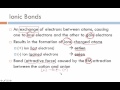
Chemical Bonding Concepts and Types

Interactive Video
•
Chemistry
•
9th - 10th Grade
•
Practice Problem
•
Hard

Patricia Brown
FREE Resource
Read more
10 questions
Show all answers
1.
MULTIPLE CHOICE QUESTION
30 sec • 1 pt
What is the primary focus of the initial chapters on chemical bonding?
Understanding the mechanics of chemical reactions
Identifying different types of chemical bonds
Studying the periodic table in detail
Learning about the history of chemistry
2.
MULTIPLE CHOICE QUESTION
30 sec • 1 pt
Why do chemical bonds form between atoms?
To increase the energy state of atoms
To create new elements
To achieve a more stable electron configuration
To decrease the number of electrons
3.
MULTIPLE CHOICE QUESTION
30 sec • 1 pt
What is a key characteristic of covalent bonds?
Atoms exchange electrons
Atoms gain protons
Atoms share electrons
Atoms lose electrons
4.
MULTIPLE CHOICE QUESTION
30 sec • 1 pt
In covalent bonding, what typically happens when two non-metal substances bond?
They lose protons
They share electrons
They form ions
They exchange electrons
5.
MULTIPLE CHOICE QUESTION
30 sec • 1 pt
What happens during the formation of ionic bonds?
Atoms share electrons
Atoms exchange electrons
Atoms gain protons
Atoms lose neutrons
6.
MULTIPLE CHOICE QUESTION
30 sec • 1 pt
What is an ion?
An atom with a charge
A neutral atom
An atom with extra protons
An atom with fewer neutrons
7.
MULTIPLE CHOICE QUESTION
30 sec • 1 pt
What type of bond involves a metal and a non-metal substance?
Covalent bond
Ionic bond
Metallic bond
Hydrogen bond
Access all questions and much more by creating a free account
Create resources
Host any resource
Get auto-graded reports

Continue with Google

Continue with Email

Continue with Classlink

Continue with Clever
or continue with

Microsoft
%20(1).png)
Apple

Others
Already have an account?

