
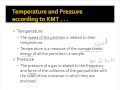
Kinetic Molecular Theory Concepts

Interactive Video
•
Physics
•
9th - 10th Grade
•
Practice Problem
•
Hard

Patricia Brown
FREE Resource
Read more
10 questions
Show all answers
1.
MULTIPLE CHOICE QUESTION
30 sec • 1 pt
What is the kinetic molecular theory primarily concerned with?
The movement of particles
The weight of particles
The color of gases
The chemical composition of gases
2.
MULTIPLE CHOICE QUESTION
30 sec • 1 pt
How are pressure and volume related according to the kinetic molecular theory?
They are inversely proportional
They are directly proportional
They are equal
They are unrelated
3.
MULTIPLE CHOICE QUESTION
30 sec • 1 pt
What happens to the pressure when the number of gas particles increases?
Pressure fluctuates
Pressure increases
Pressure remains constant
Pressure decreases
4.
MULTIPLE CHOICE QUESTION
30 sec • 1 pt
What type of collision do gas particles experience according to the kinetic molecular theory?
Inelastic
Static
Magnetic
Elastic
5.
MULTIPLE CHOICE QUESTION
30 sec • 1 pt
What is the effect of temperature on the speed of gas particles?
Temperature makes particles stop
Temperature has no effect
Higher temperature increases speed
Higher temperature decreases speed
6.
MULTIPLE CHOICE QUESTION
30 sec • 1 pt
How does temperature affect the pressure of a gas?
Pressure becomes zero
Temperature has no effect on pressure
Higher temperature increases pressure
Higher temperature decreases pressure
7.
MULTIPLE CHOICE QUESTION
30 sec • 1 pt
What does the frequency of collisions in a gas indicate?
The volume of the gas
The mass of the gas
The pressure of the gas
The color of the gas
Access all questions and much more by creating a free account
Create resources
Host any resource
Get auto-graded reports

Continue with Google

Continue with Email

Continue with Classlink

Continue with Clever
or continue with

Microsoft
%20(1).png)
Apple

Others
Already have an account?


