
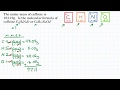
Molecular Formula and Molar Mass Concepts

Interactive Video
•
Chemistry
•
9th - 10th Grade
•
Practice Problem
•
Hard

Patricia Brown
FREE Resource
Read more
10 questions
Show all answers
1.
MULTIPLE CHOICE QUESTION
30 sec • 1 pt
What is the given molar mass of caffeine in the problem?
194.19 grams
97.11 grams
100 grams
150 grams
2.
MULTIPLE CHOICE QUESTION
30 sec • 1 pt
Which of the following is the empirical formula provided in the problem?
C6H12O6
C4H5N2O
C2H5OH
C8H10N4O2
3.
MULTIPLE CHOICE QUESTION
30 sec • 1 pt
Why is the empirical formula important in determining the molecular formula?
It provides the exact number of atoms in a molecule.
It gives the simplest whole number ratio of elements in a compound.
It is used to calculate the density of a compound.
It determines the color of the compound.
4.
MULTIPLE CHOICE QUESTION
30 sec • 1 pt
What is the molar mass of carbon used in the calculation?
16.00 grams per mole
12.01 grams per mole
14.01 grams per mole
1.01 grams per mole
5.
MULTIPLE CHOICE QUESTION
30 sec • 1 pt
How many moles of hydrogen are present in the empirical formula C4H5N2O?
1 mole
4 moles
5 moles
2 moles
6.
MULTIPLE CHOICE QUESTION
30 sec • 1 pt
What is the calculated molar mass of the empirical formula C4H5N2O?
97.11 grams
100 grams
150 grams
194.19 grams
7.
MULTIPLE CHOICE QUESTION
30 sec • 1 pt
What is the purpose of comparing the molar mass of the empirical formula with the given molar mass?
To identify the color of caffeine
To calculate the boiling point
To find the molecular formula
To determine the density of caffeine
Access all questions and much more by creating a free account
Create resources
Host any resource
Get auto-graded reports

Continue with Google

Continue with Email

Continue with Classlink

Continue with Clever
or continue with

Microsoft
%20(1).png)
Apple

Others
Already have an account?

