
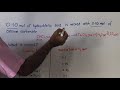
Chemical Reactions and Limiting Reagents

Interactive Video
•
Chemistry
•
9th - 10th Grade
•
Practice Problem
•
Hard

Patricia Brown
FREE Resource
Read more
10 questions
Show all answers
1.
MULTIPLE CHOICE QUESTION
30 sec • 1 pt
What are the initial quantities of hydrochloric acid and calcium carbonate used in the reaction?
0.20 moles of hydrochloric acid and 0.10 moles of calcium carbonate
0.05 moles of hydrochloric acid and 0.10 moles of calcium carbonate
0.10 moles of hydrochloric acid and 0.10 moles of calcium carbonate
0.10 moles of hydrochloric acid and 0.20 moles of calcium carbonate
2.
MULTIPLE CHOICE QUESTION
30 sec • 1 pt
What is the mole ratio between hydrochloric acid and calcium carbonate in the reaction?
3:1
1:1
2:1
1:2
3.
MULTIPLE CHOICE QUESTION
30 sec • 1 pt
Why is the mole ratio important in chemical reactions?
It determines the color of the reactants.
It helps in calculating the amount of products formed.
It indicates the temperature at which the reaction occurs.
It shows the speed of the reaction.
4.
MULTIPLE CHOICE QUESTION
30 sec • 1 pt
Which reactant is identified as the limiting reagent in this reaction?
Calcium carbonate
Water
Hydrochloric acid
Carbon dioxide
5.
MULTIPLE CHOICE QUESTION
30 sec • 1 pt
What happens to the excess reactant when the limiting reagent is completely consumed?
It changes color.
It evaporates.
It remains unreacted.
It reacts completely.
6.
MULTIPLE CHOICE QUESTION
30 sec • 1 pt
How much hydrochloric acid is needed to react with all the calcium carbonate?
0.15 moles
0.20 moles
0.05 moles
0.10 moles
7.
MULTIPLE CHOICE QUESTION
30 sec • 1 pt
What is the maximum yield of carbon dioxide in this reaction?
0.05 moles
0.10 moles
0.20 moles
0.15 moles
Access all questions and much more by creating a free account
Create resources
Host any resource
Get auto-graded reports

Continue with Google

Continue with Email

Continue with Classlink

Continue with Clever
or continue with

Microsoft
%20(1).png)
Apple

Others
Already have an account?

