
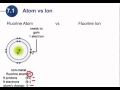
Ionic and Covalent Bonding Concepts

Interactive Video
•
Chemistry
•
9th - 10th Grade
•
Practice Problem
•
Hard

Patricia Brown
FREE Resource
Read more
10 questions
Show all answers
1.
MULTIPLE CHOICE QUESTION
30 sec • 1 pt
What is the simplest form of an element?
Molecule
Atom
Compound
Ion
2.
MULTIPLE CHOICE QUESTION
30 sec • 1 pt
What is the result when elements combine in a fixed ratio?
A new element
A new atom
A new compound
A new ion
3.
MULTIPLE CHOICE QUESTION
30 sec • 1 pt
What do valence shells aim to achieve in compound formation?
An empty outer shell
A full outer shell like noble gases
A half-filled outer shell
A shell with more protons
4.
MULTIPLE CHOICE QUESTION
30 sec • 1 pt
Which group of elements tends to gain an electron?
Transition metals
Halogens
Noble gases
Alkali metals
5.
MULTIPLE CHOICE QUESTION
30 sec • 1 pt
How does an ion differ from an atom?
An ion is always positive
An ion has a charge due to electron gain or loss
An ion has a different number of protons
An ion has a neutral charge
6.
MULTIPLE CHOICE QUESTION
30 sec • 1 pt
What happens to the sodium atom when it becomes an ion?
It gains a proton
It loses an electron
It loses a proton
It gains an electron
7.
MULTIPLE CHOICE QUESTION
30 sec • 1 pt
How are ion names typically modified?
By adding 'ate'
By adding 'ide'
By adding 'ous'
By adding 'ium'
Access all questions and much more by creating a free account
Create resources
Host any resource
Get auto-graded reports

Continue with Google

Continue with Email

Continue with Classlink

Continue with Clever
or continue with

Microsoft
%20(1).png)
Apple

Others
Already have an account?
Popular Resources on Wayground

15 questions
Fractions on a Number Line

Quiz
•
3rd Grade
20 questions
Equivalent Fractions
Quiz
•
3rd Grade
25 questions
Multiplication Facts
Quiz
•
5th Grade
29 questions
Alg. 1 Section 5.1 Coordinate Plane
Quiz
•
9th Grade
22 questions
fractions
Quiz
•
3rd Grade
11 questions
FOREST Effective communication

Lesson
•
KG
20 questions
Main Idea and Details
Quiz
•
5th Grade
20 questions
Context Clues
Quiz
•
6th Grade
Discover more resources for Chemistry
22 questions
Unit 9 Gas Law Quiz
Quiz
•
10th Grade
10 questions
Exploring Types of Chemical Reactions
Interactive video
•
6th - 10th Grade
20 questions
Types of Chemical Reactions
Quiz
•
9th - 12th Grade
20 questions
Acids and Bases
Quiz
•
10th Grade
30 questions
Energy Review
Quiz
•
9th Grade
7 questions
GCSE Chemistry - Balancing Chemical Equations #4
Interactive video
•
9th - 10th Grade
20 questions
Chemistry: Classification of Matter
Quiz
•
10th Grade
40 questions
Unit 3 (Part 1) Chemical Equations & Reactions Review Game
Quiz
•
8th - 12th Grade