
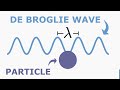
De Broglie Wavelength and Particle Behavior

Interactive Video
•
Physics
•
11th - 12th Grade
•
Practice Problem
•
Hard

Patricia Brown
FREE Resource
Read more
10 questions
Show all answers
1.
MULTIPLE CHOICE QUESTION
30 sec • 1 pt
What concept explains the ability of light and matter to exhibit both wave-like and particle-like properties?
Uncertainty principle
Quantum entanglement
Photoelectric effect
Wave-particle duality
2.
MULTIPLE CHOICE QUESTION
30 sec • 1 pt
Who proposed the idea that particles could have wave-like properties similar to light?
Max Planck
Albert Einstein
Louis de Broglie
Niels Bohr
3.
MULTIPLE CHOICE QUESTION
30 sec • 1 pt
What is the formula for the momentum of a photon?
p = E / c
p = h * lambda
p = h / lambda
p = m * v
4.
MULTIPLE CHOICE QUESTION
30 sec • 1 pt
How is the de Broglie wavelength of a particle calculated?
lambda = h * p
lambda = h / p
lambda = E / h
lambda = m * v
5.
MULTIPLE CHOICE QUESTION
30 sec • 1 pt
What happens to the de Broglie wavelength of a particle as its velocity approaches zero?
It remains constant
It becomes very small
It becomes very large
It becomes negative
6.
MULTIPLE CHOICE QUESTION
30 sec • 1 pt
When do particles behave more like classical particles according to their de Broglie wavelength?
When their wavelength is very large
When their momentum is zero
When they have a small velocity and mass
When they have a large velocity and mass
7.
MULTIPLE CHOICE QUESTION
30 sec • 1 pt
What is the thermal velocity of free electrons in a metal at room temperature?
10^3 meters per second
10^6 meters per second
10^5 meters per second
10^4 meters per second
Access all questions and much more by creating a free account
Create resources
Host any resource
Get auto-graded reports

Continue with Google

Continue with Email

Continue with Microsoft
or continue with

%20(1).png)
Apple

Others
By signing up, you agree to our Terms of Service & Privacy Policy
Already have an account?


