
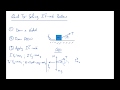
Understanding Newton's Second Law Concepts

Interactive Video
•
Physics
•
9th - 10th Grade
•
Practice Problem
•
Hard

Patricia Brown
FREE Resource
Read more
10 questions
Show all answers
1.
MULTIPLE CHOICE QUESTION
30 sec • 1 pt
What are the three steps involved in solving F = MA problems?
Drawing a diagram, measuring angles, applying friction
Calculating weight, measuring tension, applying gravity
Identifying forces, calculating mass, determining velocity
Sketching, drawing a free body diagram, applying Newton's second law
2.
MULTIPLE CHOICE QUESTION
30 sec • 1 pt
In a typical F = MA problem, what might a sketch include?
A ball rolling down a hill
A car accelerating on a highway
A pendulum swinging back and forth
A block on a surface with forces like tension and friction
3.
MULTIPLE CHOICE QUESTION
30 sec • 1 pt
What is the purpose of a free body diagram?
To determine the color of the object
To measure the distance traveled by the object
To calculate the speed of the object
To represent the object as a dot and show all forces acting on it
4.
MULTIPLE CHOICE QUESTION
30 sec • 1 pt
Which forces are typically included in a free body diagram?
Mass, volume, and density
Distance, time, and speed
Speed, velocity, and acceleration
Weight, normal force, tension, and friction
5.
MULTIPLE CHOICE QUESTION
30 sec • 1 pt
Why is it important to only include forces in a free body diagram?
To calculate the object's density
To ensure accurate application of Newton's second law
To measure the object's speed
To make the diagram colorful
6.
MULTIPLE CHOICE QUESTION
30 sec • 1 pt
What does Newton's second law help us determine in step three?
The speed of light
The temperature of the environment
The relationship between force, mass, and acceleration
The color of the object
7.
MULTIPLE CHOICE QUESTION
30 sec • 1 pt
How are forces summed in the X direction according to Newton's second law?
By subtracting normal force from tension
By dividing weight by acceleration
By adding the component of tension and subtracting friction
By multiplying mass and velocity
Access all questions and much more by creating a free account
Create resources
Host any resource
Get auto-graded reports

Continue with Google

Continue with Email

Continue with Classlink

Continue with Clever
or continue with

Microsoft
%20(1).png)
Apple

Others
Already have an account?
Popular Resources on Wayground

15 questions
Fractions on a Number Line

Quiz
•
3rd Grade
20 questions
Equivalent Fractions
Quiz
•
3rd Grade
25 questions
Multiplication Facts
Quiz
•
5th Grade
29 questions
Alg. 1 Section 5.1 Coordinate Plane
Quiz
•
9th Grade
22 questions
fractions
Quiz
•
3rd Grade
11 questions
FOREST Effective communication

Lesson
•
KG
20 questions
Main Idea and Details
Quiz
•
5th Grade
20 questions
Context Clues
Quiz
•
6th Grade
Discover more resources for Physics
10 questions
Exit Check 4.1 - Destructive Processes
Quiz
•
9th Grade
10 questions
Exit Check 4.2 - Constructive Forces
Quiz
•
9th Grade
10 questions
Exit Check 4.3 - Conservation of Momentum
Quiz
•
9th Grade
10 questions
Exit Check 4.4 - Momentum Calculations
Quiz
•
9th Grade
21 questions
EM Spectrum
Quiz
•
6th - 9th Grade
20 questions
Simple Machines and Mechanical Advantage Quiz
Quiz
•
9th Grade
14 questions
Graphs of Motion, Velocity & Acceleration
Quiz
•
8th - 9th Grade
21 questions
PE & KE Practice
Quiz
•
8th - 11th Grade