
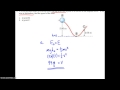
Energy Conservation and Motion Problems

Interactive Video
•
Physics
•
9th - 10th Grade
•
Practice Problem
•
Hard

Patricia Brown
FREE Resource
Read more
10 questions
Show all answers
1.
MULTIPLE CHOICE QUESTION
30 sec • 1 pt
What is the significance of the wire being frictionless in this problem?
It ensures that the bead does not lose energy to heat.
It allows the use of the work-energy theorem.
It means the bead will move in a straight line.
It allows the bead to have constant speed.
2.
MULTIPLE CHOICE QUESTION
30 sec • 1 pt
Which principle is primarily used to solve for the speed of the bead at Point B?
Work-Energy Theorem
Conservation of Momentum
Newton's Second Law
Conservation of Energy
3.
MULTIPLE CHOICE QUESTION
30 sec • 1 pt
At Point A, what type of energy does the bead possess?
Gravitational Potential Energy
Thermal Energy
Kinetic Energy
Elastic Potential Energy
4.
MULTIPLE CHOICE QUESTION
30 sec • 1 pt
What is the speed of the bead at Point B?
12.0 m/s
9.9 m/s
5.0 m/s
7.7 m/s
5.
MULTIPLE CHOICE QUESTION
30 sec • 1 pt
Why is the mass of the bead not a factor in determining its speed at Point B?
The mass is only relevant for potential energy.
The mass cancels out in the energy equations.
The bead is weightless.
The mass is too small to affect the speed.
6.
MULTIPLE CHOICE QUESTION
30 sec • 1 pt
What is the initial height used for calculating potential energy at Point C?
5 meters
3 meters
2 meters
0 meters
7.
MULTIPLE CHOICE QUESTION
30 sec • 1 pt
What is the speed of the bead at Point C?
12.0 m/s
7.7 m/s
9.9 m/s
5.0 m/s
Access all questions and much more by creating a free account
Create resources
Host any resource
Get auto-graded reports

Continue with Google

Continue with Email

Continue with Classlink

Continue with Clever
or continue with

Microsoft
%20(1).png)
Apple

Others
Already have an account?


