
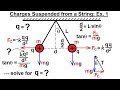
Coulomb's Law and Static Equilibrium

Interactive Video
•
Physics
•
9th - 10th Grade
•
Practice Problem
•
Hard

Patricia Brown
FREE Resource
Read more
10 questions
Show all answers
1.
MULTIPLE CHOICE QUESTION
30 sec • 1 pt
What happens to the two objects when they are charged?
They fall to the ground.
They remain stationary.
They repel each other.
They attract each other.
2.
MULTIPLE CHOICE QUESTION
30 sec • 1 pt
Which force is responsible for the objects being pushed to the side?
Gravitational force
Magnetic force
Coulomb's force
Frictional force
3.
MULTIPLE CHOICE QUESTION
30 sec • 1 pt
What is the condition for static equilibrium in this setup?
The net force is directed downwards.
The net force is directed upwards.
All forces add up to zero.
All forces add up to a non-zero value.
4.
MULTIPLE CHOICE QUESTION
30 sec • 1 pt
In the context of this problem, what does the tangent of angle theta represent?
The ratio of gravitational force to Coulomb's force
The ratio of Coulomb's force to gravitational force
The difference between gravitational and Coulomb's forces
The sum of gravitational and Coulomb's forces
5.
MULTIPLE CHOICE QUESTION
30 sec • 1 pt
How is the distance between the charges related to the angle and string length?
D = 2L * sin(theta)
D = L * cos(theta)
D = 2L * cos(theta)
D = L * tan(theta)
6.
MULTIPLE CHOICE QUESTION
30 sec • 1 pt
What is the expression for Q in terms of D, M, g, theta, and K?
Q = D * sqrt(Mg * tan(theta) / K)
Q = D * sqrt(Mg * sin(theta) / K)
Q = D * sqrt(Mg * cos(theta) / K)
Q = D * sqrt(Mg * cot(theta) / K)
7.
MULTIPLE CHOICE QUESTION
30 sec • 1 pt
What is the value of K in the context of this problem?
9 x 10^9 N m^2/C^2
8.99 x 10^9 N m^2/C^2
9.8 m/s^2
6.67 x 10^-11 N m^2/kg^2
Access all questions and much more by creating a free account
Create resources
Host any resource
Get auto-graded reports

Continue with Google

Continue with Email

Continue with Classlink

Continue with Clever
or continue with

Microsoft
%20(1).png)
Apple

Others
Already have an account?


