
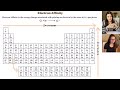
Understanding Electron Affinity Trends

Interactive Video
•
Chemistry
•
9th - 10th Grade
•
Practice Problem
•
Hard

Patricia Brown
FREE Resource
Read more
10 questions
Show all answers
1.
MULTIPLE CHOICE QUESTION
30 sec • 1 pt
What is the main difference between electron affinity and ionization energy?
Electron affinity involves removing an electron.
Ionization energy involves adding an electron.
Ionization energy involves forming an anion.
Electron affinity involves adding an electron.
2.
MULTIPLE CHOICE QUESTION
30 sec • 1 pt
How does electron affinity change across a period in the periodic table?
It decreases from left to right.
It increases from left to right.
It remains constant.
It fluctuates randomly.
3.
MULTIPLE CHOICE QUESTION
30 sec • 1 pt
What type of reaction is associated with electron affinity?
Catalytic
Neutral
Exothermic
Endothermic
4.
MULTIPLE CHOICE QUESTION
30 sec • 1 pt
In terms of electron affinity, what does a higher negative value indicate?
Less energy is released.
More energy is absorbed.
The atom becomes more positive.
More energy is released.
5.
MULTIPLE CHOICE QUESTION
30 sec • 1 pt
Which group in the periodic table has an exception to the general trend of electron affinity?
1A to 2A
3A to 4A
5A to 6A
7A to 8A
6.
MULTIPLE CHOICE QUESTION
30 sec • 1 pt
Why does nitrogen have a lower electron affinity compared to carbon?
Carbon's added electron goes into a higher energy orbital.
Carbon has more protons.
Nitrogen's added electron goes into an already occupied orbital.
Nitrogen has a full s orbital.
7.
MULTIPLE CHOICE QUESTION
30 sec • 1 pt
What happens to the electron affinity when an electron is added to a p orbital instead of an s orbital?
It becomes zero.
It decreases due to increased repulsion.
It remains unchanged.
It increases significantly.
Access all questions and much more by creating a free account
Create resources
Host any resource
Get auto-graded reports

Continue with Google

Continue with Email

Continue with Classlink

Continue with Clever
or continue with

Microsoft
%20(1).png)
Apple

Others
Already have an account?
Similar Resources on Wayground

6 questions
Understanding Roman Numerals in Ionic Compounds
Interactive video
•
9th - 10th Grade
6 questions
Understanding Argon and the Octet Rule
Interactive video
•
9th - 10th Grade
6 questions
Atoms, Ions, and Molecules Quiz
Interactive video
•
9th - 10th Grade
7 questions
thành phần cấu tạo nguyên tử
Interactive video
•
10th Grade
11 questions
Understanding Avogadro's Number and the Mole
Interactive video
•
9th - 10th Grade
11 questions
Understanding Models of Acids and Bases
Interactive video
•
9th - 10th Grade
8 questions
What is a Digital Marketing Campaign
Interactive video
•
9th - 10th Grade
6 questions
Understanding Elements in the Periodic Table
Interactive video
•
9th - 10th Grade
Popular Resources on Wayground
15 questions
Fractions on a Number Line

Quiz
•
3rd Grade
10 questions
Probability Practice
Quiz
•
4th Grade
15 questions
Probability on Number LIne
Quiz
•
4th Grade
20 questions
Equivalent Fractions
Quiz
•
3rd Grade
25 questions
Multiplication Facts
Quiz
•
5th Grade
22 questions
fractions
Quiz
•
3rd Grade
6 questions
Appropriate Chromebook Usage

Lesson
•
7th Grade
10 questions
Greek Bases tele and phon
Quiz
•
6th - 8th Grade
Discover more resources for Chemistry
20 questions
Predicting Products
Quiz
•
9th - 12th Grade
11 questions
Balancing Chemical Equations
Lesson
•
9th Grade
10 questions
Exploring Types of Chemical Reactions
Interactive video
•
6th - 10th Grade
19 questions
Stoichiometry, % yield, Limiting Reactants
Quiz
•
10th Grade
20 questions
Types of Chemical Reactions
Quiz
•
9th - 12th Grade
10 questions
Exploring Ionic and Covalent Bonding Concepts
Interactive video
•
6th - 10th Grade
7 questions
GCSE Chemistry - Balancing Chemical Equations #4
Interactive video
•
9th - 10th Grade
12 questions
Percent Yield
Quiz
•
10th Grade