
- Resource Library
- Math
- Financial Literacy
- Compound And Continuous Interest
- Continuous Compound Interest Concepts
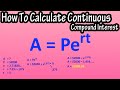
Continuous Compound Interest Concepts

Interactive Video
•
Mathematics
•
9th - 10th Grade
•
Practice Problem
•
Hard

Thomas White
FREE Resource
Read more
10 questions
Show all answers
1.
MULTIPLE CHOICE QUESTION
30 sec • 1 pt
What does the variable 'A' represent in the continuous compound interest formula?
The time in years
The yearly interest rate
The total compound amount after a certain period
The original amount invested
2.
MULTIPLE CHOICE QUESTION
30 sec • 1 pt
Which constant is used in the continuous compound interest formula and is approximately equal to 2.71828?
Euler's number (e)
Pi
Golden ratio
Planck's constant
3.
MULTIPLE CHOICE QUESTION
30 sec • 1 pt
In the example problem, what is the principal amount invested?
$4,000
$3,000
$2,000
$1,000
4.
MULTIPLE CHOICE QUESTION
30 sec • 1 pt
How is the yearly interest rate of 7.5% converted into a decimal for the formula?
0.75
0.075
0.0075
7.5
5.
MULTIPLE CHOICE QUESTION
30 sec • 1 pt
What is the value of 'T' in the example problem?
6 years
5 years
4 years
3 years
6.
MULTIPLE CHOICE QUESTION
30 sec • 1 pt
What is the first step in calculating the compound amount using the formula?
Multiply the principal by the interest rate
Multiply the interest rate by the time
Raise e to the power of the product of the interest rate and time
Add the principal to the interest
7.
MULTIPLE CHOICE QUESTION
30 sec • 1 pt
What is the result of raising e to the power of 0.375 in the example calculation?
2.71828
1.375
0.375
1.1454
Access all questions and much more by creating a free account
Create resources
Host any resource
Get auto-graded reports

Continue with Google

Continue with Email

Continue with Microsoft
or continue with

%20(1).png)
Apple

Others
By signing up, you agree to our Terms of Service & Privacy Policy
Already have an account?

