
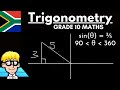
Trigonometry Concepts and Applications

Interactive Video
•
Mathematics
•
9th - 10th Grade
•
Practice Problem
•
Hard

Thomas White
FREE Resource
Read more
10 questions
Show all answers
1.
MULTIPLE CHOICE QUESTION
30 sec • 1 pt
What is the primary purpose of the CAST diagram in trigonometry?
To find the hypotenuse of a triangle
To calculate the area of a triangle
To identify the quadrant where an angle lies
To determine the length of a triangle's sides
2.
MULTIPLE CHOICE QUESTION
30 sec • 1 pt
When the quadrant is not directly given, what method is suggested to determine it?
Drawing a random triangle
Using the CAST diagram in a reverse manner
Guessing based on previous questions
Using a calculator
3.
MULTIPLE CHOICE QUESTION
30 sec • 1 pt
In which quadrants is the sine function positive?
First and fourth
Second and third
Third and fourth
First and second
4.
MULTIPLE CHOICE QUESTION
30 sec • 1 pt
What is the range of angles considered in the video for determining the correct quadrant?
90 to 180 degrees
0 to 90 degrees
180 to 360 degrees
90 to 360 degrees
5.
MULTIPLE CHOICE QUESTION
30 sec • 1 pt
Why is it important to draw the triangle in the correct quadrant?
To ensure the triangle is equilateral
To avoid incorrect answers
To make the calculations easier
To use a calculator effectively
6.
MULTIPLE CHOICE QUESTION
30 sec • 1 pt
What does the sine value of 3/5 represent in the triangle?
Hypotenuse over opposite
Adjacent over opposite
Opposite over hypotenuse
Adjacent over hypotenuse
7.
MULTIPLE CHOICE QUESTION
30 sec • 1 pt
How is the missing side of the triangle calculated using Pythagoras' theorem?
By adding the squares of the known sides
By subtracting the square of the opposite from the hypotenuse
By dividing the hypotenuse by the opposite
By multiplying the known sides
Access all questions and much more by creating a free account
Create resources
Host any resource
Get auto-graded reports

Continue with Google

Continue with Email

Continue with Classlink

Continue with Clever
or continue with

Microsoft
%20(1).png)
Apple

Others
Already have an account?
Popular Resources on Wayground

15 questions
Fractions on a Number Line

Quiz
•
3rd Grade
10 questions
Probability Practice
Quiz
•
4th Grade
15 questions
Probability on Number LIne
Quiz
•
4th Grade
20 questions
Equivalent Fractions
Quiz
•
3rd Grade
25 questions
Multiplication Facts
Quiz
•
5th Grade
22 questions
fractions
Quiz
•
3rd Grade
6 questions
Appropriate Chromebook Usage

Lesson
•
7th Grade
10 questions
Greek Bases tele and phon
Quiz
•
6th - 8th Grade
Discover more resources for Mathematics
23 questions
TSI Math Vocabulary
Quiz
•
10th - 12th Grade
15 questions
Graphing Inequalities
Quiz
•
7th - 9th Grade
20 questions
Graphing Inequalities on a Number Line
Quiz
•
6th - 9th Grade
15 questions
Combine Like Terms and Distributive Property
Quiz
•
8th - 9th Grade
10 questions
Plotting Points on a Coordinate Plane: Quadrant 1 Essentials
Interactive video
•
6th - 10th Grade
20 questions
Perfect Squares and Square Roots
Quiz
•
9th Grade
10 questions
Exploring Abiotic and Biotic Factors in Ecosystems
Interactive video
•
6th - 10th Grade
20 questions
Function or Not a Function
Quiz
•
8th - 9th Grade