
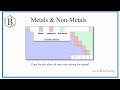
Understanding Metals, Non-Metals, and Ionic Compounds

Interactive Video
•
Chemistry
•
9th - 10th Grade
•
Practice Problem
•
Hard

Sophia Harris
FREE Resource
Read more
10 questions
Show all answers
1.
MULTIPLE CHOICE QUESTION
30 sec • 1 pt
Why is it important to understand the difference between metals and non-metals in chemistry?
To predict the smell of the compound
To identify the type of compound
To determine the color of the compound
To identify the type of chemical reaction
2.
MULTIPLE CHOICE QUESTION
30 sec • 1 pt
Where are metals generally located on the periodic table?
At the bottom
On the left side
In the middle
On the right side
3.
MULTIPLE CHOICE QUESTION
30 sec • 1 pt
Why is hydrogen placed with metals on the periodic table?
It has a similar color
It has one valence electron like group one elements
It is a gas at room temperature
It is heavier than most non-metals
4.
MULTIPLE CHOICE QUESTION
30 sec • 1 pt
Which of the following is a non-metal?
Tin
Oxygen
Aluminum
Copper
5.
MULTIPLE CHOICE QUESTION
30 sec • 1 pt
What type of compound is formed when a metal and a non-metal bond?
Covalent
Ionic
Metallic
Hydrogen
6.
MULTIPLE CHOICE QUESTION
30 sec • 1 pt
What happens to electrons in a covalent bond?
They are shared
They are transferred
They are gained
They are lost
7.
MULTIPLE CHOICE QUESTION
30 sec • 1 pt
What is the formula for magnesium fluoride using the crisscross method?
MgF2
MgF
Mg2F
Mg2F3
Access all questions and much more by creating a free account
Create resources
Host any resource
Get auto-graded reports

Continue with Google

Continue with Email

Continue with Classlink

Continue with Clever
or continue with

Microsoft
%20(1).png)
Apple

Others
Already have an account?


