
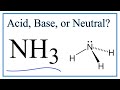
Understanding NH3: Acidity and Basicity

Interactive Video
•
Chemistry
•
9th - 10th Grade
•
Practice Problem
•
Hard

Aiden Montgomery
FREE Resource
Read more
10 questions
Show all answers
1.
MULTIPLE CHOICE QUESTION
30 sec • 1 pt
What is the classification of NH3 in terms of acidity and basicity?
Strong acid
Weak acid
Strong base
Weak base
2.
MULTIPLE CHOICE QUESTION
30 sec • 1 pt
What happens to NH3 when it is dissolved in water?
It remains mostly as NH3 with some NH4+ and OH-
It forms a strong acid
It forms a strong base
It completely dissociates into ions
3.
MULTIPLE CHOICE QUESTION
30 sec • 1 pt
According to the Arrhenius theory, what do bases produce in water?
H+ ions
NH4+ ions
OH- ions
H2O molecules
4.
MULTIPLE CHOICE QUESTION
30 sec • 1 pt
In the Bronsted-Lowry theory, what is a base defined as?
A proton acceptor
An electron pair acceptor
A proton donor
An electron pair donor
5.
MULTIPLE CHOICE QUESTION
30 sec • 1 pt
What role does water play when NH3 is dissolved in it, according to the Bronsted-Lowry theory?
It acts as a neutral compound
It acts as a base
It acts as a catalyst
It acts as an acid
6.
MULTIPLE CHOICE QUESTION
30 sec • 1 pt
What ion is formed when NH3 accepts a hydrogen ion?
NH4+
NH2-
H2O
OH-
7.
MULTIPLE CHOICE QUESTION
30 sec • 1 pt
What does the Lewis theory state about bases?
They donate an electron pair
They accept protons
They donate protons
They accept an electron pair
Access all questions and much more by creating a free account
Create resources
Host any resource
Get auto-graded reports

Continue with Google

Continue with Email

Continue with Microsoft
or continue with

%20(1).png)
Apple

Others
By signing up, you agree to our Terms of Service & Privacy Policy
Already have an account?


