
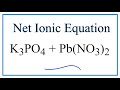
Spectator Ions and Net Ionic Equations

Interactive Video
•
Chemistry
•
10th - 12th Grade
•
Practice Problem
•
Hard

Olivia Brooks
FREE Resource
Read more
10 questions
Show all answers
1.
MULTIPLE CHOICE QUESTION
30 sec • 1 pt
What is the first step in writing a net ionic equation?
Identify spectator ions
Write the complete ionic equation
Balance the molecular equation
Determine the solubility of compounds
2.
MULTIPLE CHOICE QUESTION
30 sec • 1 pt
Why is lead(II) phosphate considered a solid in the reaction?
It is a strong electrolyte
It is insoluble in water
It is a liquid under standard conditions
It is a gas at room temperature
3.
MULTIPLE CHOICE QUESTION
30 sec • 1 pt
Which of the following compounds is generally soluble?
Potassium phosphate
Calcium phosphate
Iron(III) phosphate
Lead(II) phosphate
4.
MULTIPLE CHOICE QUESTION
30 sec • 1 pt
What is the charge of the phosphate ion?
4-
3-
2-
1-
5.
MULTIPLE CHOICE QUESTION
30 sec • 1 pt
How many potassium ions are present in the complete ionic equation?
6
4
8
2
6.
MULTIPLE CHOICE QUESTION
30 sec • 1 pt
What is the role of spectator ions in a chemical reaction?
They participate in the reaction
They remain unchanged and do not participate
They alter the charge balance
They change the state of the reaction
7.
MULTIPLE CHOICE QUESTION
30 sec • 1 pt
Which ions are considered spectator ions in this reaction?
Lead ions
Hydrogen ions
Phosphate ions
Potassium and nitrate ions
Access all questions and much more by creating a free account
Create resources
Host any resource
Get auto-graded reports

Continue with Google

Continue with Email

Continue with Classlink

Continue with Clever
or continue with

Microsoft
%20(1).png)
Apple

Others
Already have an account?


