
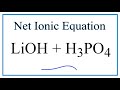
Net Ionic Equations and Spectator Ions

Interactive Video
•
Chemistry
•
10th - 12th Grade
•
Practice Problem
•
Hard

Jackson Turner
FREE Resource
Read more
10 questions
Show all answers
1.
MULTIPLE CHOICE QUESTION
30 sec • 1 pt
What is the first step in writing a net ionic equation for a reaction?
Identify spectator ions
Balance the molecular equation
Split strong electrolytes into ions
Determine the states of substances
2.
MULTIPLE CHOICE QUESTION
30 sec • 1 pt
Why is lithium hydroxide considered a strong base?
It forms a precipitate
It is a weak acid
It is insoluble in water
It dissociates completely in water
3.
MULTIPLE CHOICE QUESTION
30 sec • 1 pt
Which of the following is true about phosphoric acid in this reaction?
It is a weak acid and does not split into ions
It dissociates completely in water
It forms a solid precipitate
It is a strong acid
4.
MULTIPLE CHOICE QUESTION
30 sec • 1 pt
What is the state of lithium phosphate in the reaction?
Solid
Liquid
Gas
Aqueous
5.
MULTIPLE CHOICE QUESTION
30 sec • 1 pt
What is the purpose of splitting strong electrolytes into ions?
To form a precipitate
To determine the states of substances
To identify spectator ions
To balance the equation
6.
MULTIPLE CHOICE QUESTION
30 sec • 1 pt
Which ions are not split apart in net ionic equations?
Gas ions
Aqueous ions
Spectator ions
Solid ions
7.
MULTIPLE CHOICE QUESTION
30 sec • 1 pt
What is the net charge on both sides of the net ionic equation?
Positive
Negative
Variable
Zero
Access all questions and much more by creating a free account
Create resources
Host any resource
Get auto-graded reports

Continue with Google

Continue with Email

Continue with Microsoft
or continue with

%20(1).png)
Apple

Others
Already have an account?

