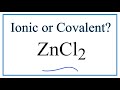
Electronegativity and Ionic Compounds

Interactive Video
•
Chemistry
•
9th - 10th Grade
•
Practice Problem
•
Hard

Lucas Foster
FREE Resource
Read more
9 questions
Show all answers
1.
MULTIPLE CHOICE QUESTION
30 sec • 1 pt
What is the main focus of the video regarding zinc chloride?
Its environmental impact
Its color and texture
Its classification as ionic or covalent
Its uses in industry
2.
MULTIPLE CHOICE QUESTION
30 sec • 1 pt
What type of elements are zinc and chlorine?
Both are metals
Both are nonmetals
Zinc is a nonmetal and chlorine is a metal
Zinc is a metal and chlorine is a nonmetal
3.
MULTIPLE CHOICE QUESTION
30 sec • 1 pt
What is the electronegativity value of zinc?
1.65
3.16
2.55
0.98
4.
MULTIPLE CHOICE QUESTION
30 sec • 1 pt
How is the electronegativity difference between zinc and chlorine calculated?
By subtracting zinc's value from chlorine's
By multiplying their values
By dividing chlorine's value by zinc's
By adding their values
5.
MULTIPLE CHOICE QUESTION
30 sec • 1 pt
What is the general electronegativity difference threshold for a compound to be considered ionic?
Greater than 2.0
Greater than 1.5
Greater than 3.0
Greater than 1.0
6.
MULTIPLE CHOICE QUESTION
30 sec • 1 pt
How is zinc chloride classified based on its electronegativity difference?
Strongly ionic
Metallic
Weakly ionic
Purely covalent
7.
MULTIPLE CHOICE QUESTION
30 sec • 1 pt
What laboratory observation supports the covalent character of zinc chloride?
It is colorless
It melts easily compared to sodium chloride
It is highly reactive with water
It has a high boiling point
Access all questions and much more by creating a free account
Create resources
Host any resource
Get auto-graded reports

Continue with Google

Continue with Email

Continue with Classlink

Continue with Clever
or continue with

Microsoft
%20(1).png)
Apple

Others
Already have an account?
Similar Resources on Wayground

6 questions
Molar Mass and Calculations Quiz
Interactive video
•
9th - 10th Grade
6 questions
Understanding Roman Numerals in Ionic Compounds
Interactive video
•
9th - 10th Grade
6 questions
Understanding Argon and the Octet Rule
Interactive video
•
9th - 10th Grade
6 questions
Testing for Bromide and Chloride Ions
Interactive video
•
9th - 10th Grade
6 questions
Understanding Covalent Bonds
Interactive video
•
9th - 10th Grade
6 questions
Understanding Ionic Bonds and Dot and Cross Diagrams
Interactive video
•
9th - 10th Grade
6 questions
Bohr Model and Electron Configuration Quiz
Interactive video
•
9th - 10th Grade
6 questions
Understanding Elements in the Periodic Table
Interactive video
•
9th - 10th Grade
Popular Resources on Wayground
15 questions
Fractions on a Number Line

Quiz
•
3rd Grade
20 questions
Equivalent Fractions
Quiz
•
3rd Grade
25 questions
Multiplication Facts
Quiz
•
5th Grade
54 questions
Analyzing Line Graphs & Tables
Quiz
•
4th Grade
22 questions
fractions
Quiz
•
3rd Grade
20 questions
Main Idea and Details
Quiz
•
5th Grade
20 questions
Context Clues
Quiz
•
6th Grade
15 questions
Equivalent Fractions
Quiz
•
4th Grade
Discover more resources for Chemistry
20 questions
Types of Chemical Reactions
Quiz
•
9th - 12th Grade
10 questions
Formative 3BC: Ionic v Covalent Bonds
Quiz
•
9th Grade
10 questions
Exploring Stoichiometry Concepts
Interactive video
•
6th - 10th Grade
20 questions
Mixed Bonding Naming
Quiz
•
9th Grade
20 questions
Naming & Writing Chemical Formulas
Quiz
•
10th Grade
20 questions
Chemical Reactions
Quiz
•
9th Grade
20 questions
Practice: E-Con, Orbital Notation, Noble Gas Notation
Quiz
•
10th Grade
20 questions
Covalent Bonding
Quiz
•
10th Grade