
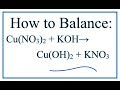
Balancing Chemical Equations with Polyatomic Ions

Interactive Video
•
Chemistry
•
9th - 10th Grade
•
Practice Problem
•
Hard

Mia Campbell
FREE Resource
Read more
9 questions
Show all answers
1.
MULTIPLE CHOICE QUESTION
30 sec • 1 pt
What type of reaction occurs when copper(II) nitrate reacts with potassium hydroxide?
Decomposition reaction
Synthesis reaction
Single displacement reaction
Double displacement reaction
2.
MULTIPLE CHOICE QUESTION
30 sec • 1 pt
Why is it helpful to treat polyatomic ions as single units when balancing chemical equations?
It simplifies the balancing process.
It makes the equation more complex.
It changes the chemical properties of the ions.
It increases the number of steps required.
3.
MULTIPLE CHOICE QUESTION
30 sec • 1 pt
In the reaction, how many nitrate ions are present on the reactant side before balancing?
One
Two
Three
Four
4.
MULTIPLE CHOICE QUESTION
30 sec • 1 pt
What coefficient is placed in front of potassium nitrate to balance the nitrates in the equation?
3
4
2
1
5.
MULTIPLE CHOICE QUESTION
30 sec • 1 pt
How many hydroxide ions are present on the product side before balancing?
Four
Three
Two
One
6.
MULTIPLE CHOICE QUESTION
30 sec • 1 pt
What is the final coefficient for potassium hydroxide to balance the hydroxides in the equation?
2
1
3
4
7.
MULTIPLE CHOICE QUESTION
30 sec • 1 pt
After balancing, how many potassium atoms are present on each side of the equation?
Three
Two
Four
One
Access all questions and much more by creating a free account
Create resources
Host any resource
Get auto-graded reports

Continue with Google

Continue with Email

Continue with Classlink

Continue with Clever
or continue with

Microsoft
%20(1).png)
Apple

Others
Already have an account?


