
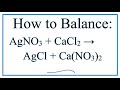
Balancing Chemical Equations with Polyatomic Ions

Interactive Video
•
Chemistry
•
9th - 10th Grade
•
Practice Problem
•
Hard

Amelia Wright
FREE Resource
Read more
7 questions
Show all answers
1.
MULTIPLE CHOICE QUESTION
30 sec • 1 pt
What is the initial step in balancing the equation involving calcium chloride and silver nitrate?
Change the chemical formula.
Add coefficients randomly.
Count the number of atoms on each side.
Ignore the polyatomic ions.
2.
MULTIPLE CHOICE QUESTION
30 sec • 1 pt
How should polyatomic ions like NO3 be treated when balancing equations?
They should be split into individual elements.
As separate atoms.
As a single unit.
They should be ignored.
3.
MULTIPLE CHOICE QUESTION
30 sec • 1 pt
What imbalance is identified after counting the atoms in the equation?
Calcium and silver are unbalanced.
Chlorines and nitrates are unbalanced.
Only nitrates are unbalanced.
All elements are balanced.
4.
MULTIPLE CHOICE QUESTION
30 sec • 1 pt
What coefficient is added in front of AgCl to balance the chlorines?
1
2
3
4
5.
MULTIPLE CHOICE QUESTION
30 sec • 1 pt
After balancing chlorines, what is the next step to balance the equation?
Remove some chlorines.
Double the silver and nitrate.
Add more calcium.
Add more silver nitrate.
6.
MULTIPLE CHOICE QUESTION
30 sec • 1 pt
What is the final step to ensure the equation is balanced?
Check the balance of nitrates.
Add more calcium chloride.
Remove excess silver.
Ignore the nitrates.
7.
MULTIPLE CHOICE QUESTION
30 sec • 1 pt
Why is it easier to count NO3 as a single item?
It is not present on both sides.
It has no effect on balancing.
It is a complex ion.
It simplifies the balancing process.
Access all questions and much more by creating a free account
Create resources
Host any resource
Get auto-graded reports

Continue with Google

Continue with Email

Continue with Classlink

Continue with Clever
or continue with

Microsoft
%20(1).png)
Apple

Others
Already have an account?


