
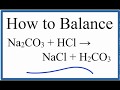
Balancing Chemical Reactions and Ions

Interactive Video
•
Chemistry
•
9th - 10th Grade
•
Practice Problem
•
Hard

Aiden Montgomery
FREE Resource
Read more
9 questions
Show all answers
1.
MULTIPLE CHOICE QUESTION
30 sec • 1 pt
What are the products formed when sodium carbonate reacts with hydrochloric acid?
Sodium hydroxide and water
Sodium bicarbonate and chlorine gas
Sodium chloride and carbonic acid
Sodium sulfate and hydrogen gas
2.
MULTIPLE CHOICE QUESTION
30 sec • 1 pt
Why is the carbonate ion treated as a single unit in the balancing process?
Because it is a common ion in reactions
Because it appears unchanged on both sides of the equation
Because it is a reactive ion
Because it is a stable compound
3.
MULTIPLE CHOICE QUESTION
30 sec • 1 pt
How many sodium atoms are present on the reactant side before balancing?
One
Three
Two
Four
4.
MULTIPLE CHOICE QUESTION
30 sec • 1 pt
What coefficient is placed in front of NaCl to balance the sodium atoms?
4
3
2
1
5.
MULTIPLE CHOICE QUESTION
30 sec • 1 pt
After balancing sodium, how many chlorine atoms are present on the product side?
One
Four
Two
Three
6.
MULTIPLE CHOICE QUESTION
30 sec • 1 pt
What adjustment is made to balance the hydrogen atoms?
Add a coefficient of 3 in front of HCl
Add a coefficient of 2 in front of HCl
Add a coefficient of 2 in front of NaCl
Add a coefficient of 3 in front of NaCl
7.
MULTIPLE CHOICE QUESTION
30 sec • 1 pt
What is the final step to ensure all atoms are balanced in the equation?
Adjust the coefficient of HCl
Adjust the coefficient of NaCl
Adjust the coefficient of Na2CO3
Adjust the coefficient of H2CO3
Access all questions and much more by creating a free account
Create resources
Host any resource
Get auto-graded reports

Continue with Google

Continue with Email

Continue with Classlink

Continue with Clever
or continue with

Microsoft
%20(1).png)
Apple

Others
Already have an account?

