
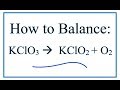
Balancing Chemical Equations Concepts

Interactive Video
•
Chemistry
•
9th - 10th Grade
•
Practice Problem
•
Hard

Olivia Brooks
FREE Resource
Read more
10 questions
Show all answers
1.
MULTIPLE CHOICE QUESTION
30 sec • 1 pt
What is the initial number of oxygen atoms on the reactant side of the equation KClO3 yields KClO2 plus O2?
3
2
1
4
2.
MULTIPLE CHOICE QUESTION
30 sec • 1 pt
Why is it important to make the number of oxygen atoms even when balancing the equation?
To simplify the calculation
To match the number of chlorine atoms
To ensure the equation is balanced
To make the equation more complex
3.
MULTIPLE CHOICE QUESTION
30 sec • 1 pt
What coefficient is placed in front of KClO3 to balance the oxygen atoms?
4
3
2
1
4.
MULTIPLE CHOICE QUESTION
30 sec • 1 pt
After placing a coefficient of 2 in front of KClO3, what is the new number of potassium atoms on the reactant side?
3
4
2
1
5.
MULTIPLE CHOICE QUESTION
30 sec • 1 pt
What is the final coefficient placed in front of KClO2 to balance the equation?
1
2
4
3
6.
MULTIPLE CHOICE QUESTION
30 sec • 1 pt
What law is obeyed when the chemical equation is balanced?
Law of Constant Composition
Law of Definite Proportions
Law of Conservation of Mass
Law of Multiple Proportions
7.
MULTIPLE CHOICE QUESTION
30 sec • 1 pt
What should you do when you encounter an odd number of atoms while balancing an equation?
Add more reactants
Make it even
Remove some products
Ignore it
Access all questions and much more by creating a free account
Create resources
Host any resource
Get auto-graded reports

Continue with Google

Continue with Email

Continue with Classlink

Continue with Clever
or continue with

Microsoft
%20(1).png)
Apple

Others
Already have an account?


