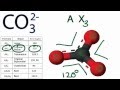
Trigonal Planar Molecular Geometry Concepts

Interactive Video
•
Chemistry
•
9th - 10th Grade
•
Practice Problem
•
Hard

Amelia Wright
FREE Resource
Read more
8 questions
Show all answers
1.
MULTIPLE CHOICE QUESTION
30 sec • 1 pt
What is the molecular geometry of CO3(2-) based on the arrangement of oxygen atoms around the central carbon atom?
Linear
Bent
Trigonal planar
Tetrahedral
2.
MULTIPLE CHOICE QUESTION
30 sec • 1 pt
In the AXN notation for CO3(2-), what does the 'X' represent?
The central atom
The number of non-bonding electron pairs
The total number of electron pairs
The number of atoms bonded to the central atom
3.
MULTIPLE CHOICE QUESTION
30 sec • 1 pt
What is the AXN notation for CO3(2-)?
AX3
AX4
AX2E
AX2
4.
MULTIPLE CHOICE QUESTION
30 sec • 1 pt
What is the bond angle in a trigonal planar molecular geometry?
109.5°
120°
90°
180°
5.
MULTIPLE CHOICE QUESTION
30 sec • 1 pt
Which of the following is true about the bond angles in CO3(2-)?
They are all 90°
They are all 120°
They vary between 90° and 120°
They are all 180°
6.
MULTIPLE CHOICE QUESTION
30 sec • 1 pt
How can the trigonal planar geometry of CO3(2-) be confirmed?
By using a molecular model kit
By looking at a table of geometries
By using a spectrometer
By measuring bond angles with a protractor
7.
MULTIPLE CHOICE QUESTION
30 sec • 1 pt
What does the three-dimensional structure of CO3(2-) show about the arrangement of oxygen atoms?
They form a square
They are spread out in a plane
They form a tetrahedral shape
They are in a straight line
Access all questions and much more by creating a free account
Create resources
Host any resource
Get auto-graded reports

Continue with Google

Continue with Email

Continue with Classlink

Continue with Clever
or continue with

Microsoft
%20(1).png)
Apple

Others
Already have an account?
Similar Resources on Wayground

11 questions
Understanding Avogadro's Number and the Mole
Interactive video
•
9th - 10th Grade
11 questions
Understanding Ionic Equations
Interactive video
•
9th - 10th Grade
11 questions
Understanding Dilution and Its Applications
Interactive video
•
9th - 10th Grade
11 questions
Understanding the Exact Area of a Yellow Ring
Interactive video
•
9th - 10th Grade
11 questions
Estuarine Depositional Environments Quiz
Interactive video
•
9th - 10th Grade
11 questions
Mathematical Trickery and the Vanishing Square Paradox
Interactive video
•
9th - 10th Grade
6 questions
Understanding Polymers
Interactive video
•
9th - 10th Grade
11 questions
Polyatomic Ions and Their Formulas
Interactive video
•
9th - 10th Grade
Popular Resources on Wayground
15 questions
Fractions on a Number Line

Quiz
•
3rd Grade
20 questions
Equivalent Fractions
Quiz
•
3rd Grade
25 questions
Multiplication Facts
Quiz
•
5th Grade
22 questions
fractions
Quiz
•
3rd Grade
20 questions
Main Idea and Details
Quiz
•
5th Grade
20 questions
Context Clues
Quiz
•
6th Grade
15 questions
Equivalent Fractions
Quiz
•
4th Grade
20 questions
Figurative Language Review
Quiz
•
6th Grade
Discover more resources for Chemistry
20 questions
Types of Chemical Reactions
Quiz
•
9th - 12th Grade
20 questions
Energy Transformations
Quiz
•
9th - 12th Grade
20 questions
Periodic Table & Trends
Quiz
•
10th Grade
20 questions
Periodic Trends
Quiz
•
10th Grade
24 questions
Identifying Types of Chemical Reactions
Quiz
•
10th - 12th Grade
20 questions
Naming & Writing Chemical Formulas
Quiz
•
10th Grade
20 questions
Atomic Structure
Quiz
•
10th - 12th Grade
10 questions
Identifying Types of Chemical Reactions
Interactive video
•
6th - 10th Grade