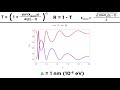
Quantum Tunneling Concepts and Applications

Interactive Video
•
Physics
•
11th Grade - University
•
Practice Problem
•
Hard

Mia Campbell
FREE Resource
Read more
10 questions
Show all answers
1.
MULTIPLE CHOICE QUESTION
30 sec • 1 pt
What is the key difference between a classical particle and a quantum particle when approaching a barrier?
A classical particle has a non-zero probability of passing through the barrier.
A classical particle can always pass through the barrier.
A quantum particle has a non-zero probability of passing through even if its energy is less than the barrier height.
A quantum particle cannot pass through the barrier if its energy is less than the barrier height.
2.
MULTIPLE CHOICE QUESTION
30 sec • 1 pt
What does the transmission coefficient T represent in quantum mechanics?
The probability of a particle being destroyed by the barrier.
The probability of a particle being reflected by the barrier.
The probability of a particle passing through the barrier.
The probability of a particle being absorbed by the barrier.
3.
MULTIPLE CHOICE QUESTION
30 sec • 1 pt
How is the transmission factor T derived in the context of quantum tunneling?
By using classical mechanics equations.
By solving a set of linear equations using algebraic manipulations.
By guessing the values based on experimental data.
By using the laws of thermodynamics.
4.
MULTIPLE CHOICE QUESTION
30 sec • 1 pt
What is the significance of the parameter eta in the context of quantum tunneling?
It represents the mass of the particle.
It represents the energy of the particle relative to the barrier height.
It represents the charge of the particle.
It represents the speed of the particle.
5.
MULTIPLE CHOICE QUESTION
30 sec • 1 pt
What is quantum tunneling?
The phenomenon where a particle is destroyed upon hitting a barrier.
The process of a particle being reflected by a barrier.
The phenomenon where a particle passes through a barrier despite having less energy than the barrier height.
The process of a particle being absorbed by a barrier.
6.
MULTIPLE CHOICE QUESTION
30 sec • 1 pt
How does the transmission coefficient T change as the energy of the particle approaches the barrier height?
T increases slightly.
T decreases to zero.
T becomes negative.
T remains constant.
7.
MULTIPLE CHOICE QUESTION
30 sec • 1 pt
What is the relationship between the transmission coefficient T and the reflection coefficient R?
T and R are independent of each other.
T plus R equals one.
T is always greater than R.
T is always less than R.
Access all questions and much more by creating a free account
Create resources
Host any resource
Get auto-graded reports

Continue with Google

Continue with Email

Continue with Classlink

Continue with Clever
or continue with

Microsoft
%20(1).png)
Apple

Others
Already have an account?
Similar Resources on Wayground

6 questions
Magic Angle Graphene and Twistronics Quiz
Interactive video
•
11th - 12th Grade
11 questions
Quantum Mechanics and Technology Quiz
Interactive video
•
11th - 12th Grade
11 questions
Muon g-2 Experiment Quiz
Interactive video
•
11th - 12th Grade
11 questions
Exploring Parallel Universes
Interactive video
•
11th - 12th Grade
Popular Resources on Wayground
15 questions
Fractions on a Number Line

Quiz
•
3rd Grade
20 questions
Equivalent Fractions
Quiz
•
3rd Grade
25 questions
Multiplication Facts
Quiz
•
5th Grade
22 questions
fractions
Quiz
•
3rd Grade
20 questions
Main Idea and Details
Quiz
•
5th Grade
20 questions
Context Clues
Quiz
•
6th Grade
15 questions
Equivalent Fractions
Quiz
•
4th Grade
20 questions
Figurative Language Review
Quiz
•
6th Grade
Discover more resources for Physics
18 questions
Universal Law of Gravitation

Lesson
•
11th Grade
20 questions
Potential and Kinetic Energy
Quiz
•
9th - 12th Grade
34 questions
Energy Review
Quiz
•
9th - 12th Grade
14 questions
Bill Nye Waves
Interactive video
•
9th - 12th Grade
24 questions
Reflection, Refraction & Diffraction
Quiz
•
6th - 12th Grade