
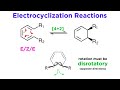
Cyclization Reactions and Mechanisms

Interactive Video
•
Chemistry
•
11th - 12th Grade
•
Practice Problem
•
Hard

Lucas Foster
FREE Resource
Read more
10 questions
Show all answers
1.
MULTIPLE CHOICE QUESTION
30 sec • 1 pt
What type of reaction involves two separate molecules forming a cyclic compound by generating two new sigma bonds?
[4 + 2] Cycloaddition
[3,3] Sigmatropic shift
6-electron electrocyclization
Nazarov cyclization
2.
MULTIPLE CHOICE QUESTION
30 sec • 1 pt
In a 6-electron electrocyclization, what happens to the pi and sigma bonds?
One pi bond is formed, and two sigma bonds are lost.
Two pi bonds are formed, and one sigma bond is lost.
One sigma bond is formed, and one pi bond is lost.
Two sigma bonds are formed, and one pi bond is lost.
3.
MULTIPLE CHOICE QUESTION
30 sec • 1 pt
What is the stereochemical requirement for a [4 + 2] electrocyclization involving an E, Z, E triene?
Conrotatory rotation of termini
Disrotatory rotation of termini
No rotation required
Random rotation of termini
4.
MULTIPLE CHOICE QUESTION
30 sec • 1 pt
Why are 4-electron cyclizations less common?
They produce unstable products.
They are too slow to be practical.
They have an anti-aromatic transition state.
They require high temperatures.
5.
MULTIPLE CHOICE QUESTION
30 sec • 1 pt
In a 4-electron cyclization, how do the termini of the diene rotate to form a new sigma bond?
Randomly
No rotation is needed
In the same direction
In opposite directions
6.
MULTIPLE CHOICE QUESTION
30 sec • 1 pt
What is the result of reacting a cyclobutene with maleic anhydride?
A single sigma bond
An aromatic compound
A complex polycyclic structure
A simple diene
7.
MULTIPLE CHOICE QUESTION
30 sec • 1 pt
What is the key feature of the cascade reaction involving tetraenes and maleic anhydride?
It forms a single product.
It involves a single reaction step.
It creates multiple chiral centers.
It is not stereoselective.
Access all questions and much more by creating a free account
Create resources
Host any resource
Get auto-graded reports

Continue with Google

Continue with Email

Continue with Microsoft
or continue with

%20(1).png)
Apple

Others
By signing up, you agree to our Terms of Service & Privacy Policy
Already have an account?


