
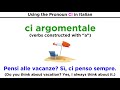
Understanding the Pronoun 'ci' in Italian

Interactive Video
•
World Languages
•
9th - 10th Grade
•
Practice Problem
•
Hard

Ethan Morris
FREE Resource
Read more
8 questions
Show all answers
1.
MULTIPLE CHOICE QUESTION
30 sec • 1 pt
What is the main difference between the pronoun 'ci' and other pronouns like 'lo', 'la', 'li', or 'le'?
It is used only in formal Italian.
It is invariable and does not change form.
It is used only with verbs starting with a vowel.
It agrees with the noun it replaces.
2.
MULTIPLE CHOICE QUESTION
30 sec • 1 pt
In the context of 'ci locativo', what does 'ci' typically refer to?
A specific time
A specific place
A specific object
A specific person
3.
MULTIPLE CHOICE QUESTION
30 sec • 1 pt
Which of the following is true about 'ci locativo'?
It must agree with the noun it replaces.
It changes form based on the verb.
It is used with direct object pronouns.
It is used to refer to places.
4.
MULTIPLE CHOICE QUESTION
30 sec • 1 pt
What is the role of 'ci' in 'ci argomentale'?
It replaces direct object pronouns.
It is used only in questions.
It is used to emphasize a statement.
It is used with verbs that require the preposition 'a'.
5.
MULTIPLE CHOICE QUESTION
30 sec • 1 pt
In 'ci argomentale', what does 'ci' mean?
For it or for them
With it or with them
About it or about them
To it or to them
6.
MULTIPLE CHOICE QUESTION
30 sec • 1 pt
What is the purpose of 'ci pleonastico' in Italian?
To indicate a question
To replace direct object pronouns
To add emphasis without specific meaning
To provide a literal translation
7.
MULTIPLE CHOICE QUESTION
30 sec • 1 pt
How is 'ci pleonastico' typically used in Italian?
In legal documents
In formal writing
In idiomatic expressions
In scientific texts
Access all questions and much more by creating a free account
Create resources
Host any resource
Get auto-graded reports

Continue with Google

Continue with Email

Continue with Classlink

Continue with Clever
or continue with

Microsoft
%20(1).png)
Apple

Others
Already have an account?

