
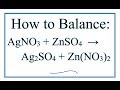
Balancing Chemical Equations with Ions

Interactive Video
•
Chemistry
•
9th - 10th Grade
•
Practice Problem
•
Hard

Emma Peterson
FREE Resource
Read more
7 questions
Show all answers
1.
MULTIPLE CHOICE QUESTION
30 sec • 1 pt
What is the initial number of silver atoms on the reactant side of the equation?
Four
One
Two
Three
2.
MULTIPLE CHOICE QUESTION
30 sec • 1 pt
Why can nitrate ions be counted as a single unit in this reaction?
They are only present in the reactants.
They remain intact during the reaction.
They change into a different ion.
They are not present in the products.
3.
MULTIPLE CHOICE QUESTION
30 sec • 1 pt
How many silver atoms are needed on the product side to balance the equation?
One
Two
Three
Four
4.
MULTIPLE CHOICE QUESTION
30 sec • 1 pt
What coefficient is placed in front of silver nitrate to balance the equation?
Three
Four
Two
One
5.
MULTIPLE CHOICE QUESTION
30 sec • 1 pt
What is the result of applying the coefficient to the nitrate ions in silver nitrate?
Three nitrate ions
Two nitrate ions
One nitrate ion
Four nitrate ions
6.
MULTIPLE CHOICE QUESTION
30 sec • 1 pt
How does treating ions as single units simplify the balancing process?
It makes the equation more complex.
It reduces the number of calculations.
It eliminates the need for coefficients.
It increases the number of steps.
7.
MULTIPLE CHOICE QUESTION
30 sec • 1 pt
What is the final balanced equation for silver nitrate and zinc sulfate?
AgNO3 + ZnSO4 → Ag2SO4 + Zn(NO3)2
2AgNO3 + ZnSO4 → Ag2SO4 + Zn
2AgNO3 + ZnSO4 → Zn(NO3)2 + Ag2SO4
AgNO3 + ZnSO4 → Zn + Ag2SO4
Access all questions and much more by creating a free account
Create resources
Host any resource
Get auto-graded reports

Continue with Google

Continue with Email

Continue with Microsoft
or continue with

%20(1).png)
Apple

Others
By signing up, you agree to our Terms of Service & Privacy Policy
Already have an account?

