
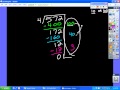
Partial Quotients and Remainders

Interactive Video
•
Mathematics
•
4th - 6th Grade
•
Practice Problem
•
Medium

Thomas White
Used 15+ times
FREE Resource
Read more
32 questions
Show all answers
1.
MULTIPLE CHOICE QUESTION
30 sec • 1 pt
What is the first step in using the partial quotients algorithm?
Divide by 2
Begin with 10 or 100
Start with the largest possible number
Multiply by 5
2.
MULTIPLE CHOICE QUESTION
30 sec • 1 pt
What is the purpose of using partial quotients in division?
To multiply numbers
To break down division into manageable steps
To simplify addition
To find the greatest common divisor
3.
MULTIPLE CHOICE QUESTION
30 sec • 1 pt
What is the benefit of starting with 10 or 100 in partial quotients?
It makes calculations faster
It reduces errors
It simplifies subtraction
It provides a clear starting point
4.
MULTIPLE CHOICE QUESTION
30 sec • 1 pt
What is the significance of the number 10 in partial quotients?
It is a common starting point
It is the final quotient
It is the divisor
It is the remainder
5.
MULTIPLE CHOICE QUESTION
30 sec • 1 pt
What is the significance of the number 100 in partial quotients?
It is the remainder
It is a common starting point
It is the final quotient
It is the divisor
6.
MULTIPLE CHOICE QUESTION
30 sec • 1 pt
In the problem 78 divided by 6, what is the first partial quotient used?
12
10
8
5
7.
MULTIPLE CHOICE QUESTION
30 sec • 1 pt
After subtracting 60 from 78 in the division problem, what is the next step?
Find a smaller partial quotient
Subtract 18
Multiply by 6
Add 10
Access all questions and much more by creating a free account
Create resources
Host any resource
Get auto-graded reports

Continue with Google

Continue with Email

Continue with Microsoft
or continue with

%20(1).png)
Apple

Others
By signing up, you agree to our Terms of Service & Privacy Policy
Already have an account?

