
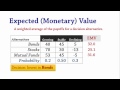
Decision-Making Under Risk Concepts

Interactive Video
•
Business
•
9th - 10th Grade
•
Practice Problem
•
Hard

Thomas White
FREE Resource
Read more
15 questions
Show all answers
1.
MULTIPLE CHOICE QUESTION
30 sec • 1 pt
What is decision-making under risk often referred to as?
Decision-making with certainty
Decision-making with probabilities
Decision-making with ambiguity
Decision-making with intuition
2.
MULTIPLE CHOICE QUESTION
30 sec • 1 pt
What does the Expected Monetary Value (EMV) represent?
The sum of all possible outcomes
The highest possible profit
The average profit weighted by probabilities
The lowest possible loss
3.
MULTIPLE CHOICE QUESTION
30 sec • 1 pt
How is the EMV for Bonds calculated?
0.2 x 53 + 0.5 x 45 + 0.3 x -5
0.2 x 70 + 0.5 x 30 + 0.3 x -13
0.2 x 40 + 0.5 x 45 + 0.3 x 5
0.2 x 60 + 0.5 x 50 + 0.3 x 10
4.
MULTIPLE CHOICE QUESTION
30 sec • 1 pt
Which investment option has the highest EMV?
Stocks
Bonds
Real Estate
Mutual Funds
5.
MULTIPLE CHOICE QUESTION
30 sec • 1 pt
What does EVPI stand for?
Expected Value of Predictive Information
Expected Value of Partial Information
Expected Value of Perfect Information
Expected Value of Probable Information
6.
MULTIPLE CHOICE QUESTION
30 sec • 1 pt
What does EVPI help determine?
The maximum profit possible
The value of additional perfect information
The minimum risk involved
The average expected loss
7.
MULTIPLE CHOICE QUESTION
30 sec • 1 pt
How is EVPI calculated?
EV with PI x EV without PI
EV with PI + EV without PI
EV with PI - EV without PI
EV without PI - EV with PI
Access all questions and much more by creating a free account
Create resources
Host any resource
Get auto-graded reports

Continue with Google

Continue with Email

Continue with Classlink

Continue with Clever
or continue with

Microsoft
%20(1).png)
Apple

Others
Already have an account?

