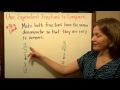
Understanding Equivalent Fractions and Denominators

Interactive Video
•
Mathematics
•
4th - 5th Grade
•
Practice Problem
•
Hard

Thomas White
Used 2+ times
FREE Resource
Read more
7 questions
Show all answers
1.
MULTIPLE CHOICE QUESTION
30 sec • 1 pt
What is the main idea behind equivalent fractions?
They represent different parts of a whole.
They have different names but represent the same amount.
They have different values.
They are always greater than one.
2.
MULTIPLE CHOICE QUESTION
30 sec • 1 pt
Which of the following is an example of equivalent fractions using fraction towers?
1/5 and 3/10
1/2 and 3/6
1/3 and 2/5
1/4 and 2/8
3.
MULTIPLE CHOICE QUESTION
30 sec • 1 pt
How can equivalent fractions be identified on a number line?
They are always at one.
They are at the same point.
They are at different points.
They are always at zero.
4.
MULTIPLE CHOICE QUESTION
30 sec • 1 pt
What does the identity property state about multiplying or dividing by one?
The number changes.
The number becomes zero.
The number remains the same.
The number doubles.
5.
MULTIPLE CHOICE QUESTION
30 sec • 1 pt
Why is it useful to convert fractions to have the same denominator?
To make them equal to one.
To make them larger.
To make them smaller.
To easily compare their sizes.
6.
MULTIPLE CHOICE QUESTION
30 sec • 1 pt
What is the first step in finding a common denominator?
List multiples of the denominators.
Add the numerators.
Subtract the denominators.
Multiply the fractions.
7.
MULTIPLE CHOICE QUESTION
30 sec • 1 pt
In the example comparing 2/3 and 7/9, what is the least common multiple used?
6
9
18
12
Access all questions and much more by creating a free account
Create resources
Host any resource
Get auto-graded reports

Continue with Google

Continue with Email

Continue with Classlink

Continue with Clever
or continue with

Microsoft
%20(1).png)
Apple

Others
Already have an account?
Similar Resources on Wayground
Popular Resources on Wayground

15 questions
Fractions on a Number Line

Quiz
•
3rd Grade
20 questions
Equivalent Fractions
Quiz
•
3rd Grade
25 questions
Multiplication Facts
Quiz
•
5th Grade
22 questions
fractions
Quiz
•
3rd Grade
20 questions
Main Idea and Details
Quiz
•
5th Grade
20 questions
Context Clues
Quiz
•
6th Grade
15 questions
Equivalent Fractions
Quiz
•
4th Grade
20 questions
Figurative Language Review
Quiz
•
6th Grade
Discover more resources for Mathematics
25 questions
Multiplication Facts
Quiz
•
5th Grade
15 questions
Equivalent Fractions
Quiz
•
4th Grade
10 questions
Multiplying Fractions
Quiz
•
5th Grade
77 questions
Mixed Multiplication and Division Facts
Quiz
•
4th Grade
19 questions
Equivalent Fractions
Quiz
•
4th Grade
14 questions
Fractions to Decimals & Decimals to Fractions
Quiz
•
4th Grade
18 questions
Adding and subtracting like denominators quiz
Quiz
•
4th Grade
20 questions
Multiplying and Dividing Decimals
Quiz
•
5th Grade