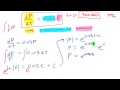
Exponential Growth and Decay Concepts

Interactive Video
•
Mathematics
•
9th - 10th Grade
•
Practice Problem
•
Hard

Thomas White
FREE Resource
Read more
8 questions
Show all answers
1.
MULTIPLE CHOICE QUESTION
30 sec • 1 pt
What is the primary focus of revisiting exponential growth and decay in this section?
To introduce new mathematical concepts
To review and deepen understanding of previously learned concepts
To discuss unrelated mathematical theories
To solve complex calculus problems
2.
MULTIPLE CHOICE QUESTION
30 sec • 1 pt
How does the growth rate relate to the size of the population?
It is independent of the population size
It is proportional to the population size
It decreases as the population size increases
It is inversely proportional to the population size
3.
MULTIPLE CHOICE QUESTION
30 sec • 1 pt
What mathematical tool is introduced to model exponential growth?
Algebraic equations
Differential equations
Geometric sequences
Arithmetic sequences
4.
MULTIPLE CHOICE QUESTION
30 sec • 1 pt
What is the first step in solving the differential equation for exponential growth?
Applying the quadratic formula
Using substitution
Separating the variables
Integrating both sides immediately
5.
MULTIPLE CHOICE QUESTION
30 sec • 1 pt
What does the constant 'e' represent in the solution of the differential equation?
The base of natural logarithms
The initial population
The growth rate
A constant of integration
6.
MULTIPLE CHOICE QUESTION
30 sec • 1 pt
How does the continuous growth model differ from the discrete growth model?
It does not involve exponential functions
It uses a different base for calculations
It assumes growth is continuous over time
It assumes growth occurs at discrete intervals
7.
MULTIPLE CHOICE QUESTION
30 sec • 1 pt
What happens to the growth rate in an exponential decay scenario?
It remains constant
It becomes negative
It becomes positive
It becomes zero
Access all questions and much more by creating a free account
Create resources
Host any resource
Get auto-graded reports

Continue with Google

Continue with Email

Continue with Classlink

Continue with Clever
or continue with

Microsoft
%20(1).png)
Apple

Others
Already have an account?
Similar Resources on Wayground

11 questions
Understanding Mean and Sampling in Statistics
Interactive video
•
9th - 12th Grade
8 questions
Shortest Distance Between Two Lines in Space
Interactive video
•
9th - 10th Grade
6 questions
CLEAN : Croatia votes on move to ban gay marriage
Interactive video
•
9th - 10th Grade
11 questions
Sample Proportions and Expected Values
Interactive video
•
9th - 10th Grade
11 questions
Sampling Methods and Data Types
Interactive video
•
9th - 10th Grade
11 questions
Direct and Inverse Variation Concepts
Interactive video
•
9th - 10th Grade
11 questions
Bone Health and Osteoporosis Concepts
Interactive video
•
9th - 10th Grade
11 questions
Understanding Maps and Cartography Concepts
Interactive video
•
9th - 10th Grade
Popular Resources on Wayground
8 questions
2 Step Word Problems

Quiz
•
KG - University
20 questions
Comparing Fractions
Quiz
•
4th Grade
15 questions
Fractions on a Number Line
Quiz
•
3rd Grade
20 questions
Equivalent Fractions
Quiz
•
3rd Grade
25 questions
Multiplication Facts
Quiz
•
5th Grade
10 questions
Latin Bases claus(clois,clos, clud, clus) and ped
Quiz
•
6th - 8th Grade
22 questions
fractions
Quiz
•
3rd Grade
7 questions
The Story of Books
Quiz
•
6th - 8th Grade
Discover more resources for Mathematics
8 questions
2 Step Word Problems
Quiz
•
KG - University
20 questions
Graphing Inequalities on a Number Line
Quiz
•
6th - 9th Grade
10 questions
Finding Area and Circumference of a Circle
Interactive video
•
6th - 10th Grade
12 questions
Exponential Growth and Decay
Quiz
•
9th Grade
13 questions
Model Exponential Growth and Decay Scenarios
Quiz
•
9th - 12th Grade
15 questions
Combine Like Terms and Distributive Property
Quiz
•
8th - 9th Grade
15 questions
TSI Math Practice Questions
Quiz
•
8th - 12th Grade
20 questions
Systems of Equations - Substitution
Quiz
•
9th Grade