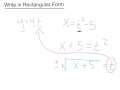
Converting Parametric Equations to Rectangular Form

Interactive Video
•
Mathematics
•
9th - 10th Grade
•
Practice Problem
•
Hard

Thomas White
FREE Resource
Read more
9 questions
Show all answers
1.
MULTIPLE CHOICE QUESTION
30 sec • 1 pt
What is the primary goal when converting a parametric equation to rectangular form?
To eliminate the parameter and express the equation in terms of X and Y.
To introduce a new parameter for simplification.
To convert the equation into a quadratic form.
To express the equation in terms of polar coordinates.
2.
MULTIPLE CHOICE QUESTION
30 sec • 1 pt
What is the first step in converting a parametric equation to rectangular form?
Solve the Y equation for the parameter.
Solve the X equation for the parameter.
Directly substitute the parameter into the Y equation.
Find the domain restrictions first.
3.
MULTIPLE CHOICE QUESTION
30 sec • 1 pt
Why is it important to consider domain restrictions when converting to rectangular form?
To convert the equation into a linear form.
To simplify the equation further.
To avoid undefined expressions like division by zero or square roots of negative numbers.
To ensure the equation is in polar form.
4.
MULTIPLE CHOICE QUESTION
30 sec • 1 pt
In the example with parameter T, what is the resulting rectangular equation?
y = 4t + 5
y = ±4√(x + 5)
y = x^2 - 5
y = 4x + 5
5.
MULTIPLE CHOICE QUESTION
30 sec • 1 pt
What is the domain restriction for the equation y = ±4√(x + 5)?
x must be less than or equal to 5
x must be greater than 5
x must be greater than or equal to -5
x must be less than -5
6.
MULTIPLE CHOICE QUESTION
30 sec • 1 pt
In the trigonometric example, what parameter is used instead of T?
Alpha
Beta
Theta
Gamma
7.
MULTIPLE CHOICE QUESTION
30 sec • 1 pt
What identity is used to simplify the trigonometric parametric equations?
The angle subtraction identity
The sum-to-product identity
The double angle identity
The Pythagorean identity
Access all questions and much more by creating a free account
Create resources
Host any resource
Get auto-graded reports

Continue with Google

Continue with Email

Continue with Classlink

Continue with Clever
or continue with

Microsoft
%20(1).png)
Apple

Others
Already have an account?
Popular Resources on Wayground

15 questions
Fractions on a Number Line

Quiz
•
3rd Grade
20 questions
Equivalent Fractions
Quiz
•
3rd Grade
25 questions
Multiplication Facts
Quiz
•
5th Grade
22 questions
fractions
Quiz
•
3rd Grade
20 questions
Main Idea and Details
Quiz
•
5th Grade
20 questions
Context Clues
Quiz
•
6th Grade
15 questions
Equivalent Fractions
Quiz
•
4th Grade
20 questions
Figurative Language Review
Quiz
•
6th Grade
Discover more resources for Mathematics
20 questions
Graphing Inequalities on a Number Line
Quiz
•
6th - 9th Grade
12 questions
Exponential Growth and Decay
Quiz
•
9th Grade
20 questions
Exponent Rules Review
Quiz
•
8th - 9th Grade
25 questions
Complementary and Supplementary Angles
Quiz
•
7th - 10th Grade
12 questions
Add and Subtract Polynomials
Quiz
•
9th - 12th Grade
13 questions
Model Exponential Growth and Decay Scenarios
Quiz
•
9th - 12th Grade
15 questions
Combine Like Terms and Distributive Property
Quiz
•
8th - 9th Grade
27 questions
7.2.3 Quadrilateral Properties
Quiz
•
9th - 12th Grade