
Ancient Measurement Techniques and Angles

Interactive Video
•
Physics
•
9th - 10th Grade
•
Practice Problem
•
Hard

Thomas White
FREE Resource
Read more
11 questions
Show all answers
1.
MULTIPLE CHOICE QUESTION
30 sec • 1 pt
What historical tool was used for navigation before modern maps and GPS?
Astrolabe
Compass
Sextant
Chronometer
2.
MULTIPLE CHOICE QUESTION
30 sec • 1 pt
What is the primary purpose of directing a telescope to a faraway star from a satellite?
To measure the star's brightness
To calculate the satellite's altitude
To determine the satellite's speed
To measure the star's location
3.
MULTIPLE CHOICE QUESTION
30 sec • 1 pt
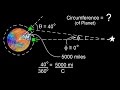
How far did the satellite travel around the unknown planet in the example?
10,000 miles
7,000 miles
5,000 miles
3,000 miles
4.
MULTIPLE CHOICE QUESTION
30 sec • 1 pt
What angle did the star move through as observed from the satellite?
60 degrees
50 degrees
40 degrees
30 degrees
5.
MULTIPLE CHOICE QUESTION
30 sec • 1 pt
Why can the angle between two lines to a faraway star be ignored?
Because it is irrelevant to the measurement
Because it is always 90 degrees
Because it is too small to affect calculations
Because it is always exactly zero
6.
MULTIPLE CHOICE QUESTION
30 sec • 1 pt
What is the relationship between the angle traveled and the circumference of the planet?
The angle is equal to the circumference
The angle is unrelated to the circumference
The angle is inversely proportional to the circumference
The angle is directly proportional to the circumference
7.
MULTIPLE CHOICE QUESTION
30 sec • 1 pt
What is the calculated circumference of the unknown planet in the example?
35,000 miles
40,000 miles
45,000 miles
50,000 miles
Access all questions and much more by creating a free account
Create resources
Host any resource
Get auto-graded reports

Continue with Google

Continue with Email

Continue with Classlink

Continue with Clever
or continue with

Microsoft
%20(1).png)
Apple

Others
Already have an account?


