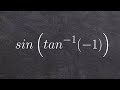
Trigonometric Functions and Their Properties

Interactive Video
•
Mathematics
•
9th - 10th Grade
•
Practice Problem
•
Hard

Thomas White
FREE Resource
Read more
8 questions
Show all answers
1.
MULTIPLE CHOICE QUESTION
30 sec • 1 pt
What does the inverse function represent in the context of trigonometry?
The square of a trigonometric function
The reciprocal of a trigonometric function
The derivative of a trigonometric function
The angle that produces a given trigonometric value
2.
MULTIPLE CHOICE QUESTION
30 sec • 1 pt
How is tangent typically represented in a right triangle?
Hypotenuse over opposite
Opposite over adjacent
Adjacent over hypotenuse
Adjacent over opposite
3.
MULTIPLE CHOICE QUESTION
30 sec • 1 pt
On the unit circle, what does the tangent of an angle represent?
The x-coordinate
The y-coordinate
The ratio of y-coordinate to x-coordinate
The ratio of x-coordinate to y-coordinate
4.
MULTIPLE CHOICE QUESTION
30 sec • 1 pt
Which angle has a tangent value of one?
30 degrees
90 degrees
45 degrees
60 degrees
5.
MULTIPLE CHOICE QUESTION
30 sec • 1 pt
What happens to the coordinates when you flip them over the y-axis?
The x-coordinate becomes negative
The y-coordinate becomes negative
Both coordinates become negative
Both coordinates remain the same
6.
MULTIPLE CHOICE QUESTION
30 sec • 1 pt
What is the constraint for the tangent function?
0 to pi
Negative pi to pi
Negative pi halves to pi halves
0 to 2pi
7.
MULTIPLE CHOICE QUESTION
30 sec • 1 pt
Why is it important to consider constraints when finding angles?
To find the largest possible angle
To avoid negative angles
To simplify calculations
To ensure angles are within a valid range
Access all questions and much more by creating a free account
Create resources
Host any resource
Get auto-graded reports

Continue with Google

Continue with Email

Continue with Classlink

Continue with Clever
or continue with

Microsoft
%20(1).png)
Apple

Others
Already have an account?
Popular Resources on Wayground

15 questions
Fractions on a Number Line

Quiz
•
3rd Grade
20 questions
Equivalent Fractions
Quiz
•
3rd Grade
25 questions
Multiplication Facts
Quiz
•
5th Grade
22 questions
fractions
Quiz
•
3rd Grade
20 questions
Main Idea and Details
Quiz
•
5th Grade
20 questions
Context Clues
Quiz
•
6th Grade
15 questions
Equivalent Fractions
Quiz
•
4th Grade
20 questions
Figurative Language Review
Quiz
•
6th Grade
Discover more resources for Mathematics
20 questions
Graphing Inequalities on a Number Line
Quiz
•
6th - 9th Grade
12 questions
Exponential Growth and Decay
Quiz
•
9th Grade
20 questions
Exponent Rules Review
Quiz
•
8th - 9th Grade
25 questions
Complementary and Supplementary Angles
Quiz
•
7th - 10th Grade
12 questions
Add and Subtract Polynomials
Quiz
•
9th - 12th Grade
13 questions
Model Exponential Growth and Decay Scenarios
Quiz
•
9th - 12th Grade
15 questions
Combine Like Terms and Distributive Property
Quiz
•
8th - 9th Grade
27 questions
7.2.3 Quadrilateral Properties
Quiz
•
9th - 12th Grade