
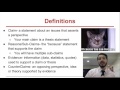
Analyzing Arguments and Evidence

Interactive Video
•
English
•
11th - 12th Grade
•
Hard

Richard Gonzalez
FREE Resource
Read more
9 questions
Show all answers
1.
MULTIPLE CHOICE QUESTION
30 sec • 1 pt
Why is understanding argument structure important in academic settings?
It is only useful for oral presentations.
It is essential for crafting persuasive essays.
It helps in writing creative stories.
It is not relevant to academic success.
2.
MULTIPLE CHOICE QUESTION
30 sec • 1 pt
What is the primary goal of an argument?
To state accepted facts.
To entertain the audience.
To convince others of a position using evidence.
To confuse the reader.
3.
MULTIPLE CHOICE QUESTION
30 sec • 1 pt
What type of evidence should be avoided in arguments?
Professional journal articles.
Historical data with substantiated credibility.
Blogs and Wiki Answers.
Statistics and expert quotes.
4.
MULTIPLE CHOICE QUESTION
30 sec • 1 pt
What is a claim in the context of an argument?
A random statement.
A statement that asserts a perspective.
A question about a topic.
An unrelated opinion.
5.
MULTIPLE CHOICE QUESTION
30 sec • 1 pt
Why is evidence crucial in supporting claims?
It provides credibility to the argument.
It confuses the reader.
It is not necessary for strong arguments.
It makes the argument more colorful.
6.
MULTIPLE CHOICE QUESTION
30 sec • 1 pt
What is the purpose of addressing counterclaims?
To make the argument longer.
To strengthen the argument by addressing alternate perspectives.
To ignore opposing views.
To confuse the audience.
7.
MULTIPLE CHOICE QUESTION
30 sec • 1 pt
What is the first step in structuring an argument?
Contextualizing the issue in the introduction.
Listing all possible evidence.
Ignoring the reader's perspective.
Writing the conclusion.
Access all questions and much more by creating a free account
Create resources
Host any resource
Get auto-graded reports

Continue with Google

Continue with Email

Continue with Classlink

Continue with Clever
or continue with

Microsoft
%20(1).png)
Apple

Others
Already have an account?
Popular Resources on Wayground

8 questions
Spartan Way - Classroom Responsible

Quiz
•
9th - 12th Grade
15 questions
Fractions on a Number Line
Quiz
•
3rd Grade
14 questions
Boundaries & Healthy Relationships

Lesson
•
6th - 8th Grade
20 questions
Equivalent Fractions
Quiz
•
3rd Grade
3 questions
Integrity and Your Health
Lesson
•
6th - 8th Grade
25 questions
Multiplication Facts
Quiz
•
5th Grade
9 questions
FOREST Perception
Lesson
•
KG
20 questions
Main Idea and Details
Quiz
•
5th Grade
Discover more resources for English
15 questions
ACT Reading Practice
Quiz
•
11th Grade
20 questions
Grammar
Quiz
•
9th - 12th Grade
20 questions
Text Structures
Quiz
•
9th - 12th Grade
4 questions
4F Use Evidence to Support Understanding
Quiz
•
9th - 12th Grade
10 questions
ACT 5: Paired Passage (Humanities)
Quiz
•
11th Grade
53 questions
Romeo and Juliet Acts 1-5
Quiz
•
9th - 12th Grade
20 questions
Editing and Revising Practice
Quiz
•
9th - 11th Grade
20 questions
Implicit vs. Explicit
Quiz
•
6th Grade - University