
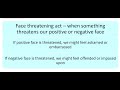
Understanding Face Theory Concepts

Interactive Video
•
English
•
9th - 10th Grade
•
Hard

Richard Gonzalez
FREE Resource
Read more
8 questions
Show all answers
1.
MULTIPLE CHOICE QUESTION
30 sec • 1 pt
What is the primary focus of Brown and Leveson's Face Theory?
The rules of English grammar
The history of the English language
The structure of English sentences
The desire to be liked and independent
2.
MULTIPLE CHOICE QUESTION
30 sec • 1 pt
What does 'positive face' refer to in Face Theory?
The skill of writing effectively
The need to be liked and appreciated
The desire to be independent
The ability to speak fluently
3.
MULTIPLE CHOICE QUESTION
30 sec • 1 pt
Which of the following is an example of a face-threatening act to positive face?
Offering help to someone
Excluding someone from a group
Inviting someone to a party
Praising someone's work
4.
MULTIPLE CHOICE QUESTION
30 sec • 1 pt
What might someone feel if their negative face is threatened?
Grateful
Offended
Embarrassed
Pleased
5.
MULTIPLE CHOICE QUESTION
30 sec • 1 pt
How can a face-saving act be described?
An act that criticizes someone's behavior
An act that mitigates threats to someone's face
An act that enhances someone's reputation
An act that ignores someone's feelings
6.
MULTIPLE CHOICE QUESTION
30 sec • 1 pt
Which statement is an example of a face-saving act?
Your work is not good enough.
I think you might enjoy this festival.
You should call your grandma now.
My food is cold, redo it.
7.
MULTIPLE CHOICE QUESTION
30 sec • 1 pt
What is a key consideration when writing about face theory?
Focusing only on positive face
Using complex vocabulary
Avoiding any examples
Providing context for examples
Access all questions and much more by creating a free account
Create resources
Host any resource
Get auto-graded reports

Continue with Google

Continue with Email

Continue with Classlink

Continue with Clever
or continue with

Microsoft
%20(1).png)
Apple

Others
Already have an account?


