
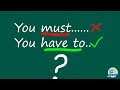
Understanding Modal Verbs in English

Interactive Video
•
English
•
6th - 7th Grade
•
Practice Problem
•
Hard

Richard Gonzalez
FREE Resource
Read more
15 questions
Show all answers
1.
MULTIPLE CHOICE QUESTION
30 sec • 1 pt
What is the main focus of this lesson?
The use of past tense in English.
How to form questions in English.
The difference between 'must' and 'have to'.
The difference between 'can' and 'may'.
2.
MULTIPLE CHOICE QUESTION
30 sec • 1 pt
Which sentence is incorrect?
I will work late tomorrow.
I must work late yesterday.
I have to work late today.
I had to work late yesterday.
3.
MULTIPLE CHOICE QUESTION
30 sec • 1 pt
Why is 'I must work late yesterday' incorrect?
Because 'must' is only used for present actions.
Because 'must' is not used in questions.
Because 'must' is only used for future actions.
Because 'must' is not used for past actions.
4.
MULTIPLE CHOICE QUESTION
30 sec • 1 pt
Which sentence is more natural?
Jim will work from 9:00 a.m. to 5:00 p.m. every Saturday.
Jim has to work from 9:00 a.m. to 5:00 p.m. every Saturday.
Jim must work from 9:00 a.m. to 5:00 p.m. every Saturday.
Jim can work from 9:00 a.m. to 5:00 p.m. every Saturday.
5.
MULTIPLE CHOICE QUESTION
30 sec • 1 pt
Why is 'must' considered unnatural for obligations?
Because 'must' is not used for obligations.
Because 'must' is only used for past actions.
Because 'must' is only used for suggestions.
Because 'must' implies a choice.
6.
MULTIPLE CHOICE QUESTION
30 sec • 1 pt
Which sentence is unnatural?
You should wear a seatbelt or you can't drive.
You have to wear a seatbelt or you can't drive.
You could wear a seatbelt or you can't drive.
You must wear a seatbelt or you can't drive.
7.
MULTIPLE CHOICE QUESTION
30 sec • 1 pt
In which situation can both 'must' and 'have to' be used correctly?
When expressing a personal choice.
When talking about past actions.
When asking a question.
When giving a command.
Access all questions and much more by creating a free account
Create resources
Host any resource
Get auto-graded reports

Continue with Google

Continue with Email

Continue with Classlink

Continue with Clever
or continue with

Microsoft
%20(1).png)
Apple

Others
Already have an account?

