
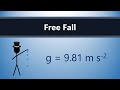
Understanding Free Fall and Kinematic Equations

Interactive Video
•
Physics
•
9th - 10th Grade
•
Practice Problem
•
Hard

Jennifer Brown
FREE Resource
10 questions
Show all answers
1.
MULTIPLE CHOICE QUESTION
30 sec • 1 pt
What is the primary force acting on an object in free fall?
Magnetic force
Air resistance
Gravity
Friction
2.
MULTIPLE CHOICE QUESTION
30 sec • 1 pt
In the absence of air resistance, how do a feather and a bowling ball fall?
They do not fall
They fall at the same rate
The bowling ball falls faster
The feather falls faster
3.
MULTIPLE CHOICE QUESTION
30 sec • 1 pt
What is the standard value of gravitational acceleration used in calculations on Earth?
9.81 m/s²
10.5 m/s²
7.5 m/s²
8.9 m/s²
4.
MULTIPLE CHOICE QUESTION
30 sec • 1 pt
Which kinematic equation is used when time is not a required variable?
v² = u² + 2as
s = ut + 1/2 at²
s = vt - 1/2 at²
v = u + at
5.
MULTIPLE CHOICE QUESTION
30 sec • 1 pt
If you drop an object from a height, what is its initial velocity?
9.81 m/s
0 m/s
Depends on the height
10 m/s
6.
MULTIPLE CHOICE QUESTION
30 sec • 1 pt
When an object is thrown upwards, what is its velocity at the highest point?
Negative velocity
Equal to initial velocity
Zero
Maximum velocity
7.
MULTIPLE CHOICE QUESTION
30 sec • 1 pt
What happens to the velocity of an object thrown upwards as it reaches its peak?
It increases
It becomes negative
It remains constant
It decreases to zero
Access all questions and much more by creating a free account
Create resources
Host any resource
Get auto-graded reports

Continue with Google

Continue with Email

Continue with Classlink

Continue with Clever
or continue with

Microsoft
%20(1).png)
Apple

Others
Already have an account?

