
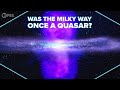
Exploring the Milky Way and Fermi Bubbles

Interactive Video
•
Physics
•
9th - 12th Grade
•
Practice Problem
•
Hard

Jennifer Brown
FREE Resource
10 questions
Show all answers
1.
MULTIPLE CHOICE QUESTION
30 sec • 1 pt
What is the primary characteristic of active galactic nuclei (AGNs)?
They are always inactive.
They contain a supermassive black hole consuming gas.
They are smaller than quasars.
They are found only in the Milky Way.
2.
MULTIPLE CHOICE QUESTION
30 sec • 1 pt
What unexpected discovery did astronomers make using the Fermi Gamma-ray Space Telescope?
A new planet in the Milky Way
A pair of high-energy gamma ray bubbles
A black hole in the Andromeda galaxy
A new type of star
3.
MULTIPLE CHOICE QUESTION
30 sec • 1 pt
What process is responsible for generating gamma rays in the Fermi Bubbles?
Gravitational lensing
Radioactive decay
Inverse Compton Scattering
Nuclear fusion
4.
MULTIPLE CHOICE QUESTION
30 sec • 1 pt
What is one theory for the origin of the Fermi Bubbles?
A nearby quasar
A large asteroid impact
A series of supernova explosions
A collision with another galaxy
5.
MULTIPLE CHOICE QUESTION
30 sec • 1 pt
What is the second theory for the creation of the Fermi Bubbles?
A collision with a comet
A nearby supernova
A massive solar flare
A temper tantrum from Sagittarius A*
6.
MULTIPLE CHOICE QUESTION
30 sec • 1 pt
What recent discovery was made using the MeerKAT telescope array?
A new planet in the Milky Way
A new galaxy
Two bubble-shaped radio structures
A new type of black hole
7.
MULTIPLE CHOICE QUESTION
30 sec • 1 pt
What is the main difference between the radio bubbles and the Fermi Bubbles?
Radio bubbles are larger
Radio bubbles are more energetic
Radio bubbles are found in other galaxies
Radio bubbles are younger
Access all questions and much more by creating a free account
Create resources
Host any resource
Get auto-graded reports

Continue with Google

Continue with Email

Continue with Microsoft
or continue with

%20(1).png)
Apple

Others
By signing up, you agree to our Terms of Service & Privacy Policy
Already have an account?

