
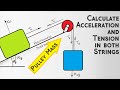
Physics Quiz on Newton's Laws and Pulley Systems

Interactive Video
•
Physics
•
9th - 10th Grade
•
Practice Problem
•
Hard

Jennifer Brown
FREE Resource
10 questions
Show all answers
1.
MULTIPLE CHOICE QUESTION
30 sec • 1 pt
What is the primary focus of the problem discussed in the video?
Calculating the mass of the blocks
Determining the acceleration and tension in the system
Measuring the angle of the inclined plane
Finding the velocity of the blocks
2.
MULTIPLE CHOICE QUESTION
30 sec • 1 pt
Which forces are considered when applying Newton's Second Law to Block 1?
Gravity and friction
Normal force and air resistance
Magnetic force and tension
Tension and the component of gravity down the hill
3.
MULTIPLE CHOICE QUESTION
30 sec • 1 pt
In the context of Block 1, what is the significance of establishing a positive direction?
It ensures the block moves faster
It simplifies the calculation of forces
It helps in determining the mass of the block
It aids in correctly applying Newton's Second Law
4.
MULTIPLE CHOICE QUESTION
30 sec • 1 pt
For Block 2, what is considered the positive direction?
Up the hill
Down the hill
Upward
Downward
5.
MULTIPLE CHOICE QUESTION
30 sec • 1 pt
Why can't Newton's Second Law be directly applied to the pulley?
The pulley is too small
The pulley is not moving
The pulley rotates, requiring torque analysis
The pulley is not connected to the blocks
6.
MULTIPLE CHOICE QUESTION
30 sec • 1 pt
What role does the mass of the pulley play in the system?
It only affects the normal force
It determines the speed of the blocks
It is negligible and can be ignored
It affects the tension in the string
7.
MULTIPLE CHOICE QUESTION
30 sec • 1 pt
How is angular acceleration related to linear acceleration in the context of the pulley?
Angular acceleration is twice the linear acceleration
Angular acceleration is the square of linear acceleration
Angular acceleration is unrelated to linear acceleration
Angular acceleration is linear acceleration divided by the radius
Access all questions and much more by creating a free account
Create resources
Host any resource
Get auto-graded reports

Continue with Google

Continue with Email

Continue with Classlink

Continue with Clever
or continue with

Microsoft
%20(1).png)
Apple

Others
Already have an account?

