
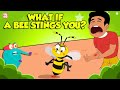
Understanding Honeybee Behavior and Stings

Interactive Video
•
Biology
•
6th - 7th Grade
•
Practice Problem
•
Hard

Jennifer Brown
FREE Resource
10 questions
Show all answers
1.
MULTIPLE CHOICE QUESTION
30 sec • 1 pt
What should you do if you encounter a beehive?
Run away quickly to avoid getting stung.
Approach it slowly to observe the bees.
Throw stones at it to scare the bees away.
Ignore it and continue with your activity.
2.
MULTIPLE CHOICE QUESTION
30 sec • 1 pt
What is the primary role of honeybees in nature?
To sting intruders.
To produce wax for candles.
To build large nests in trees.
To collect nectar and pollen and make honey.
3.
MULTIPLE CHOICE QUESTION
30 sec • 1 pt
How do honeybees defend their hives?
By flying away to a new location.
By making loud buzzing noises.
By hiding in the hive.
By using their venomous stingers.
4.
MULTIPLE CHOICE QUESTION
30 sec • 1 pt
What happens to a honeybee after it stings?
It loses its stinger and dies.
It flies away unharmed.
It becomes stronger.
It can sting multiple times.
5.
MULTIPLE CHOICE QUESTION
30 sec • 1 pt
What should be done first if a bee stinger is left in the skin?
Ignore it and let it fall out naturally.
Cover it with a bandage.
Remove the stinger carefully.
Apply honey to the sting site.
6.
MULTIPLE CHOICE QUESTION
30 sec • 1 pt
Which of the following is a sign of a severe allergic reaction to a bee sting?
Mild itching at the sting site.
Slight redness around the sting.
Difficulty breathing.
Feeling sleepy.
7.
MULTIPLE CHOICE QUESTION
30 sec • 1 pt
What is a recommended way to prevent bee stings?
Stay calm and avoid swatting at bees.
Spray perfume to mask your scent.
Wave your arms to scare them away.
Wear bright colors to attract bees.
Access all questions and much more by creating a free account
Create resources
Host any resource
Get auto-graded reports

Continue with Google

Continue with Email

Continue with Classlink

Continue with Clever
or continue with

Microsoft
%20(1).png)
Apple

Others
Already have an account?

