
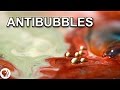
Understanding Antibubbles

Interactive Video
•
Physics
•
9th - 10th Grade
•
Practice Problem
•
Hard

Nancy Jackson
FREE Resource
10 questions
Show all answers
1.
MULTIPLE CHOICE QUESTION
30 sec • 1 pt
What happens when you flick a Q-tip across the surface of the milk and food coloring experiment?
The liquid evaporates.
Little beads roll across the surface.
The liquid turns solid.
The colors mix completely.
2.
MULTIPLE CHOICE QUESTION
30 sec • 1 pt
What is an antibubble?
A solid sphere floating in water.
A gas bubble in a vacuum.
A thin film of gas enclosing a liquid sphere.
A regular bubble floating in air.
3.
MULTIPLE CHOICE QUESTION
30 sec • 1 pt
How does the structure of an antibubble differ from a regular bubble?
Antibubbles are made of solid particles.
Antibubbles float in air.
Antibubbles have a gas film enclosing liquid.
Antibubbles have a solid core.
4.
MULTIPLE CHOICE QUESTION
30 sec • 1 pt
What is the role of hydrophilic heads in soap molecules for regular bubbles?
They evaporate quickly.
They dissolve in water.
They repel water molecules.
They attract water molecules.
5.
MULTIPLE CHOICE QUESTION
30 sec • 1 pt
What happens when you add food coloring to the antibubble experiment?
The structure of antibubbles becomes visible.
The liquid turns black.
The antibubbles become solid.
The antibubbles disappear.
6.
MULTIPLE CHOICE QUESTION
30 sec • 1 pt
Why do antibubbles pop more easily than regular bubbles?
They are exposed to more air.
They lack electric repulsive forces.
They are larger in size.
They are made of weaker materials.
7.
MULTIPLE CHOICE QUESTION
30 sec • 1 pt
What is a suggested method to make antibubbles sink?
Add more water.
Use a heavier container.
Use a vacuum pump.
Add corn syrup to increase density.
Access all questions and much more by creating a free account
Create resources
Host any resource
Get auto-graded reports

Continue with Google

Continue with Email

Continue with Classlink

Continue with Clever
or continue with

Microsoft
%20(1).png)
Apple

Others
Already have an account?


