
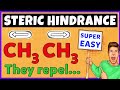
Understanding Steric Hindrance

Interactive Video
•
Chemistry
•
10th - 12th Grade
•
Practice Problem
•
Hard

Jennifer Brown
FREE Resource
10 questions
Show all answers
1.
MULTIPLE CHOICE QUESTION
30 sec • 1 pt
What is steric hindrance?
Attraction between two bonded groups
Repulsion between two non-bonding groups
Formation of a new bond between groups
Breaking of a bond between groups
2.
MULTIPLE CHOICE QUESTION
30 sec • 1 pt
What happens when the distance between two alkyl groups is less than the van der Waals radius?
They remain unaffected
They attract each other
They form a new bond
They repel each other
3.
MULTIPLE CHOICE QUESTION
30 sec • 1 pt
Why is trans-but-2-ene more stable than cis-but-2-ene?
Trans-but-2-ene has more steric hindrance
Cis-but-2-ene is more reactive
Cis-but-2-ene has less steric hindrance
Trans-but-2-ene has no steric hindrance
4.
MULTIPLE CHOICE QUESTION
30 sec • 1 pt
What is the effect of increased steric hindrance on molecular stability?
Increases stability
Stability fluctuates
Decreases stability
Has no effect
5.
MULTIPLE CHOICE QUESTION
30 sec • 1 pt
In an SN2 reaction, which type of carbon is most reactive?
Methyl carbon
Primary carbon
Tertiary carbon
Secondary carbon
6.
MULTIPLE CHOICE QUESTION
30 sec • 1 pt
Why is an SN2 reaction slower in secondary carbons compared to primary carbons?
Less steric hindrance in secondary carbons
Less nucleophiles in secondary carbons
More steric hindrance in secondary carbons
More nucleophiles in secondary carbons
7.
MULTIPLE CHOICE QUESTION
30 sec • 1 pt
Why is an SN2 reaction not possible in tertiary carbons?
Due to high steric hindrance
Due to high nucleophilic attack
Due to low steric hindrance
Due to low nucleophilic attack
Access all questions and much more by creating a free account
Create resources
Host any resource
Get auto-graded reports

Continue with Google

Continue with Email

Continue with Microsoft
or continue with

%20(1).png)
Apple

Others
Already have an account?

