
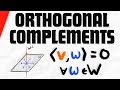
Orthogonal Complements in Inner Product Spaces Quiz

Interactive Video
•
Mathematics
•
11th - 12th Grade
•
Practice Problem
•
Hard

Nancy Jackson
FREE Resource
10 questions
Show all answers
1.
MULTIPLE CHOICE QUESTION
30 sec • 1 pt
What is the orthogonal complement of a subspace W in an inner product space V?
The set of all vectors in V that are parallel to W
The set of all vectors in V that are orthogonal to every vector in W
The set of all vectors in W that are orthogonal to V
The set of all vectors in W that are parallel to V
2.
MULTIPLE CHOICE QUESTION
30 sec • 1 pt
Which of the following is true about the intersection of a subspace and its orthogonal complement?
It contains no vectors
It contains only the zero vector
It contains all vectors in the orthogonal complement
It contains all vectors in the subspace
3.
MULTIPLE CHOICE QUESTION
30 sec • 1 pt
What is the significance of the zero vector in the context of orthogonal complements?
It is not part of any orthogonal complement
It is the only vector common to a subspace and its orthogonal complement
It is irrelevant to orthogonal complements
It is the basis of every orthogonal complement
4.
MULTIPLE CHOICE QUESTION
30 sec • 1 pt
Why is the orthogonal complement of a subspace considered a subspace itself?
Because it contains all vectors in the original space
Because it is non-empty and closed under addition and scalar multiplication
Because it is not closed under addition
Because it is empty
5.
MULTIPLE CHOICE QUESTION
30 sec • 1 pt
How do you prove that the orthogonal complement is closed under addition?
By showing that the sum of any two vectors in the complement is not orthogonal to any vector in the subspace
By showing that the sum of any two vectors in the complement is in the original subspace
By showing that the sum of any two vectors in the complement is orthogonal to every vector in the subspace
By showing that the sum of any two vectors in the complement is zero
6.
MULTIPLE CHOICE QUESTION
30 sec • 1 pt
What property of inner products is used to show closure under scalar multiplication for orthogonal complements?
Non-degeneracy
Symmetry
Homogeneity
Additivity
7.
MULTIPLE CHOICE QUESTION
30 sec • 1 pt
What happens when you take the orthogonal complement of the orthogonal complement of a subspace?
You get a different subspace
You get the zero vector
You get the original subspace
You get the entire vector space
Access all questions and much more by creating a free account
Create resources
Host any resource
Get auto-graded reports

Continue with Google

Continue with Email

Continue with Classlink

Continue with Clever
or continue with

Microsoft
%20(1).png)
Apple

Others
Already have an account?

