
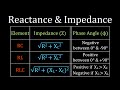
Understanding Resistance, Reactance, and Impedance

Interactive Video
•
Physics
•
10th - 12th Grade
•
Practice Problem
•
Hard

Nancy Jackson
FREE Resource
10 questions
Show all answers
1.
MULTIPLE CHOICE QUESTION
30 sec • 1 pt
What is resistance primarily considered as in the context of electron flow?
A friction against the motion of electrons
A gravitational pull on electrons
A force that accelerates electrons
A magnetic field around electrons
2.
MULTIPLE CHOICE QUESTION
30 sec • 1 pt
How is resistance measured?
In amperes
In ohms
In volts
In watts
3.
MULTIPLE CHOICE QUESTION
30 sec • 1 pt
What is the phase angle between voltage and current in a pure resistor?
0 degrees
45 degrees
90 degrees
180 degrees
4.
MULTIPLE CHOICE QUESTION
30 sec • 1 pt
How is reactance different from resistance?
Reactance is the magnetic field around a conductor
Reactance is the acceleration of electron flow
Reactance is the friction against electron motion
Reactance is the inertia against changes in current and voltage
5.
MULTIPLE CHOICE QUESTION
30 sec • 1 pt
In a capacitive circuit, how does the current relate to the voltage?
Current is opposite to voltage
Current is in phase with voltage
Current lags voltage by 90 degrees
Current leads voltage by 90 degrees
6.
MULTIPLE CHOICE QUESTION
30 sec • 1 pt
In a capacitive circuit, where is the voltage placed in the phaser diagram?
Along the positive X-axis
Along the negative Y-axis
Along the positive Y-axis
Along the negative X-axis
7.
MULTIPLE CHOICE QUESTION
30 sec • 1 pt
What is the phase relationship between voltage and current in an inductive circuit?
Voltage and current are opposite
Voltage leads current by 90 degrees
Voltage lags current by 90 degrees
Voltage and current are in phase
Access all questions and much more by creating a free account
Create resources
Host any resource
Get auto-graded reports

Continue with Google

Continue with Email

Continue with Classlink

Continue with Clever
or continue with

Microsoft
%20(1).png)
Apple

Others
Already have an account?


